CJC-1295: the human numbers belong to the long-acting form
One trial in healthy adults, one clear result: a week of raised GH and IGF-I from a single injection. The catch is chemical. The tested molecule carried an albumin-binding add-on, and a preparation without it is a different pharmacokinetic story.
29 September 2026 · 2 min read
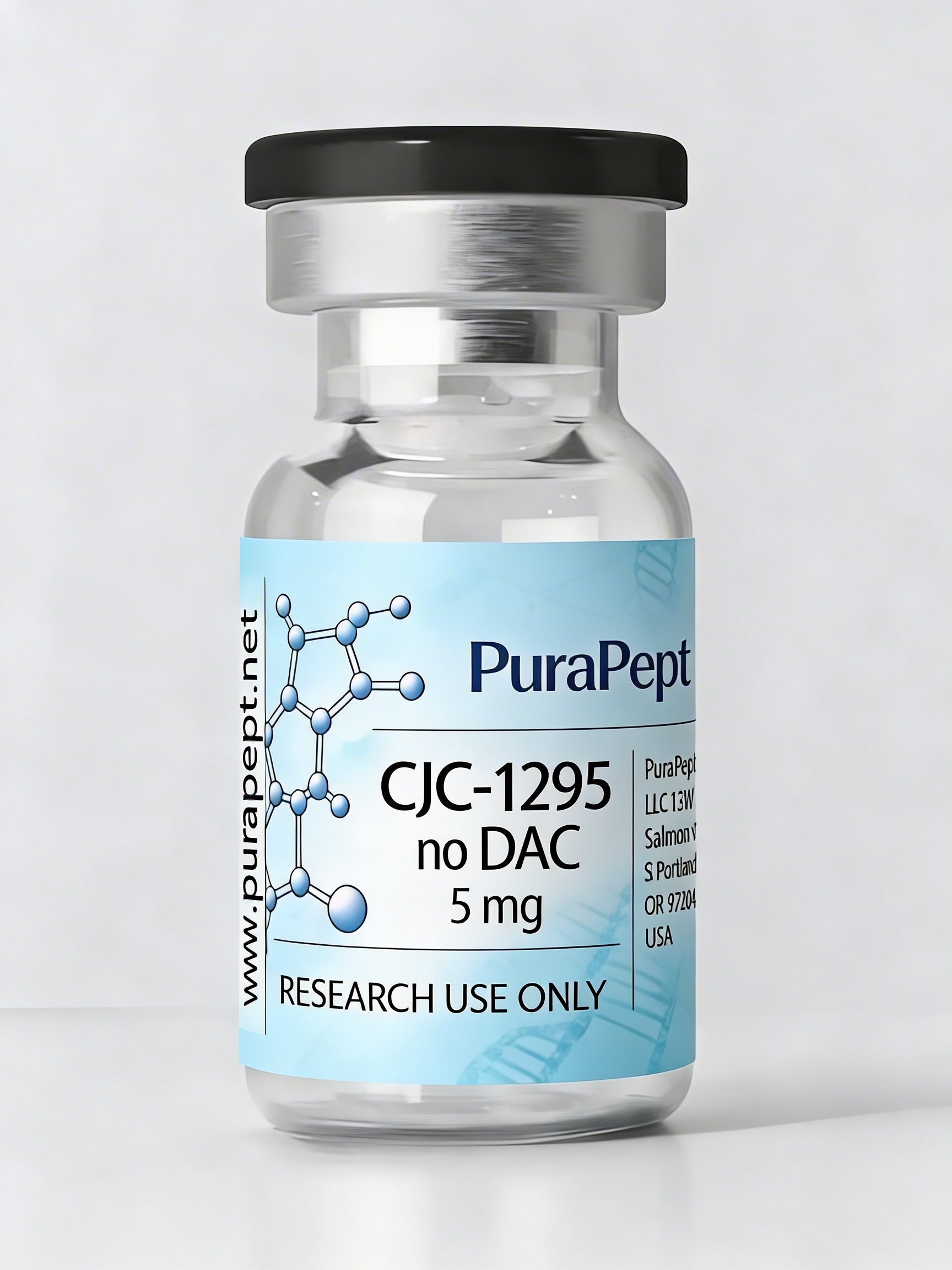 CJC-1295 no DAC 5 mg
Native GHRH has a practical problem: it vanishes. The peptide that tells the pituitary to release growth hormone is chewed up within minutes, which is why the therapeutic idea always needed a version that survives. CJC-1295 was built to be that version, and the human trial that tested it is worth reading closely, because the result and the chemistry are inseparable.
What the chemists actually made
CJC-1295 is not native GHRH with a tweak. Jette’s 2005 paper describes a tetrasubstituted hGRF(1-29) with a maleimide group stuck on the C-terminal lysine, designed to latch onto cysteine-34 of serum albumin once injected. Albumin is the most abundant protein in blood and clears slowly, so anything riding it inherits a long stay. In rats the conjugate appeared on the albumin band within 15 minutes, stayed in circulation beyond a day, and was still detectable in plasma past 72 hours, with four times the GH output of native hGRF over two hours. The same paper notes the conjugates resist dipeptidylpeptidase-IV, the enzyme that normally shreds the native peptide. The long action is not a property of the sequence. It is a property of the add-on.
What happened in people
Teichman ran the molecule in healthy adults, ages 21 to 61, across two randomised, placebo-controlled, double-blind ascending-dose trials lasting 28 and 49 days. A single injection raised mean GH two- to tenfold for six days or more and IGF-I one-and-a-half to threefold for nine to eleven days, dose-dependently. The estimated half-life was just under six to just over eight days. Repeat dosing kept IGF-I above baseline for up to 28 days, with signs the effect compounds. No serious adverse reactions turned up, and the authors called the 30 and 60 microgram-per-kilo doses relatively well tolerated.
Those are real human numbers, in a real journal, and they are the reason CJC-1295 gets cited the way it does.
The part that gets dropped
Both papers tested the albumin-binding form. The half-life of six to eight days, the week of raised GH, the IGF-I tail past a month on repeat dosing: all of it was measured on the molecule with the maleimide-lysine hook attached. A preparation that lacks that chemistry does not inherit those numbers. It inherits the sequence, which on its own is the thing DPP-IV evolved to destroy.
One catalogue note for researchers: the preparation on this page is CJC-1295 no DAC, the form without the albumin-binding complex. Read the trial figures above as data on the DAC form, not as its pharmacokinetics. Match the preparation to the question before the work starts.
What the data do not show
A week-long GH pulse from any GHRH analog, a basis for comparing forms by trial numbers measured on only one of them, or any efficacy claim beyond healthy-adult pharmacology. What exists is narrower and still useful: proof that a GHRH analog can be engineered for weekly kinetics in people, the exact chemistry that achieved it, and a clean negative control in the native peptide that clears in minutes. Everything else is extrapolation.
Research use only. This page summarises published human pharmacology and animal chemistry for research reference. It is not medical advice and not a suggestion for human use. Nothing we supply is for human or veterinary use.
References.
- Teichman SL, et al. Prolonged stimulation of growth hormone (GH) and insulin-like growth factor I secretion by CJC-1295, a long-acting analog of GH-releasing hormone, in healthy adults. J Clin Endocrinol Metab 2006. PubMed record (PMID 16352683).
- Jette L, et al. Human growth hormone-releasing factor (hGRF)1-29-albumin bioconjugates activate the GRF receptor on the anterior pituitary in rats: identification of CJC-1295 as a long-lasting GRF analog. Endocrinology 2005. PubMed record (PMID 15817669).