Methenolone: one 19-patient anaemia trial, one receptor paper
The human treatment record on methenolone cited here is a 1979 trial in 19 consecutive patients with refractory anaemia, where remissions were 3/6 in pancytopenia, 2/4 in bicytopenia, 1/5 in refractory anaemia with hyperplastic marrow and 1/4 in myelofibrosis, with no obvious prolongation of survival and negligible side effects. A 2025 Cell paper identifies methenolone as a ligand for a newly described androgen membrane receptor. The other five records measure the compound in food, in laboratory urine and in a calf.
22 October 2026 · 5 min read
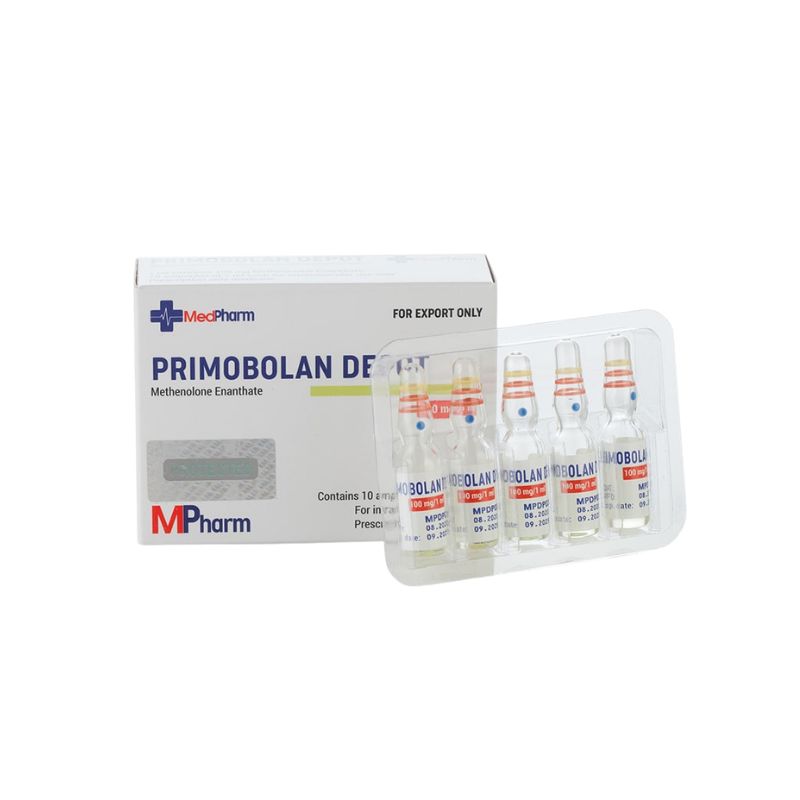 Primobolan Depot (Methenolone Enanthate)
Methenolone is the active compound in the depot preparation sold on this site. It is one of the 17-alpha-alkylated anabolic steroids, related to mesterolone and used in veterinary medicine as a growth promoter as well. Here is what eight indexed papers measured.
The only human treatment trial
A 1979 paper in Acta Medica Scandinavica reports a therapeutic trial with methenolone, named in the title as Primobolan, in 19 consecutive patients with different types of refractory anaemia. The remission frequencies were: pancytopenia 3 of 6, bicytopenia 2 of 4, refractory anaemia with hyperplastic marrow 1 of 5, and myelofibrosis 1 of 4. There was no obvious prolongation of survival in the patients who responded, and side effects were described as negligible.
Those are the whole of the numbers: seven remissions among 19 patients, spread across four diagnoses, with no survival benefit and no toxicity signal. It is a single-arm open trial in haematology, not a performance study, and it is now nearly half a century old.
The second human citation is a 1962 note in Medizinische Welt, “Methenolone enanthate (primobolan depot) in postoperative therapy”, six pages. It has no abstract in PubMed, no author list beyond the first name, and no numbers, so nothing is quoted from it here. It is listed because a postoperative indication is exactly the kind of claim that needs a source, and this record cannot supply one.
The 2025 receptor paper
The most scientifically interesting record on this page is also the newest. A 2025 paper in Cell reports the identification, structure and agonist design of an androgen membrane receptor. The authors state that androgens such as 5α-dihydrotestosterone regulate numerous functions by binding to nuclear androgen receptors and to potentially unknown membrane receptors, and report that 5α-DHT activates the membrane receptor GPR133 in muscle cells, thereby increasing intracellular cyclic AMP levels and enhancing muscle strength.
Methenolone appears in that paper as the derivative whose cryo-electron microscopy structure with GPR133-Gs was solved alongside 5α-DHT, which is how the structural basis for androgen recognition was established. Two sequence motifs are described as recognising the hydrophobic steroid core and polar groups respectively — (F/L)2.64-F3.40-W6.53 and F7.42×N/D7.46 — and the authors note that both are common in adhesion GPCRs, suggesting many adhesion GPCRs may recognise steroid hormones. The work also reports a small molecule, AP503, that activates GPR133 and separates the muscle-strengthening effects from side effects mediated by the nuclear androgen receptor.
One caution about how to read it: the abstract describes muscle strength as an outcome but does not state the model it was measured in, so the number of steps between this paper and a finding in a person cannot be counted from the abstract. What the abstract does establish is that methenolone binds a receptor, and that the authors think separating that from nuclear receptor effects is worth engineering towards.
The rat trial
A 2024 randomised trial in the Journal of Oral Pathology and Medicine tested methenolone enanthate against medication-related osteonecrosis of the jaw in rats. Thirty-six Wistar rats were divided into three groups: two experimental groups took zoledronic acid for 6 weeks before extraction of the left maxillary first molar, and one of those groups was also given methenolone enanthate continuously for 1 week before and 4 weeks after the extraction, while the control group received no medication. Six rats died during the experiment.
The measured socket outcomes, at 40× for osteoclast counts and 100× for empty lacunae, were: bone exposure rate 0% in controls, 75% in the zoledronic acid group and 10% in the group that also received methenolone; attached osteoclasts 4%, 1% and 2.1%; empty lacunae 0.8%, 8% and 3%. Significant differences were found between all groups on the number of empty lacunae, and between the control and methenolone groups against the zoledronic acid group on bone exposure rate, inflammation, hyperaemia, collagen fibre organisation and epithelialisation. The authors’ conclusion is that in this preclinical model methenolone enanthate has shown potential for preventing medication-related osteonecrosis of the jaw.
This is a rat jaw model of a bisphosphonate complication, with six of the thirty-six animals lost. It is not a muscle study.
The four papers about food and laboratories
These four share one property: they measure methenolone in something other than a treated patient.
A 1994 paper in Clinical Chemistry asked a practical question with an uncomfortable answer. Eight men consumed chickens that had either been fed methenolone acetate at 1 mg/day from day 0 to 21, or injected with methenolone heptanoate depot at 1 mg per intramuscular injection on days 0, 7 and 14 and slaughtered on day 22. No methenolone or characteristic major metabolite was detected in samples from subjects who ate meat from the orally dosed chickens. Fifty per cent of samples collected 24 hours after consumption of the intramuscularly dosed chickens were confirmed positive. The authors conclude that eating meat containing small amounts of injected hormone may constitute a serious liability to the athlete.
A 2021 paper in Drug Testing and Analysis built an HPLC-MS/MS method with sample preparation for free and conjugated methenolone in pork, beef, mutton, milk and eggs, using d3-methyltestosterone as internal standard, over a linear range of 0.5-20 µg/kg with a limit of detection of 0.3 µg/kg, precision under 7% relative standard deviation and recovery over 90%. A 2023 paper in the same journal applies Girard’s Reagent T derivatisation to intact phase II metabolites of methenolone and mesterolone in urine, with full validation for 3α-hydroxy-1-methylen-5α-androstan-17-one-3-glucuronide.
And a 2007 paper in Veterinary Research Communications studied the metabolism of methenolone acetate in a male veal calf, reporting three main metabolites in urine and faeces with α-methenolone apparently the main one, detectable in urine until 5 days after the last treatment and not detectable in faeces after 3 days. The paper notes that the use of anabolic steroids has been banned in the European Union since 1981.
What the data do not show
They do not show a muscle or strength outcome in a person. The one human treatment trial measured haematological remission in 19 patients with refractory anaemia; the receptor paper is a structural and cell-biology paper; the rat trial measured bone exposure in a jaw.
They do not show a body composition or fat loss result. Nothing here reports fat mass, lean mass or bodyweight as an efficacy outcome in people.
They do not show a modern duration of use. The largest human treatment duration on this page is not stated in the one paper that reports patients at all; the newest clinical-adjacent paper is a rat jaw model.
They do not show that a laboratory negative means no exposure. The 1994 food paper is the clearest counter-example: half the samples were positive from meat alone.
Where this sits on the shelf
The compound as supplied by the manufacturer: Primobolan Depot (Methenolone Enanthate)
What we supply
The methenolone preparation above, as supplied by the manufacturer, tracked, from inside the EU.
Research use only. This page summarises published studies for research reference. It is not medical advice, not a protocol, and not a suggestion for human use. Nothing we supply is for human or veterinary use.
References.
- Lockner D. Treatment of refractory anemias with methenolone. Acta Med Scand 1979;205(1-2):97-101.
- Fixson U. Methenolone enanthate (primobolan depot) in postoperative therapy. Med Welt 1962;19:1109-14. No abstract is indexed in PubMed; nothing is quoted from it here.
- Yang Z, Ping YQ, Wang MW, et al. Identification, structure, and agonist design of an androgen membrane receptor. Cell 2025;188(6):1589-1604.e24.
- Gurses G, Sur E, Cengiz ZO, et al. Evaluation of Methenolone Enanthate Efficacy in Preventing MRONJ: A Randomized Trial on Rats. J Oral Pathol Med 2024;53(8):530-537.
- Kicman AT, Cowan DA, Myhre L, et al. Effect on sports drug tests of ingesting meat from steroid (methenolone)-treated livestock. Clin Chem 1994;40(11 Pt 1):2084-7.
- Zheng J, Ye C, Wang P, et al. Quantitative analysis of total methenolone in animal source food by liquid chromatography-tandem mass spectrometry. Drug Test Anal 2021;13(1):148-155.
- Van Hoof N, Courtheyn D, Gillis W, et al. Metabolism of methenolone acetate in a veal calf. Vet Res Commun 2007;31(3):259-72.
- Angelis YS, Fragkaki AG, Kiousi P, et al. LC-MS/(MS) confirmatory doping control analysis of intact phase II metabolites of methenolone and mesterolone after Girard's Reagent T derivatization. Drug Test Anal 2023;15(6):654-667.