Methyltrienolone (R1881): the androgen that lives in the lab
R1881 is the synthetic androgen most of the androgen-receptor literature uses as its reference ligand. Its binding constants, its non-aromatisation, its placental binding protein and its effects on cultured granulosa cells are all documented in print. Not one of those records is a human administration trial. This page reports the measured numbers and states plainly what kind of evidence each one is.
24 October 2026 · 5 min read
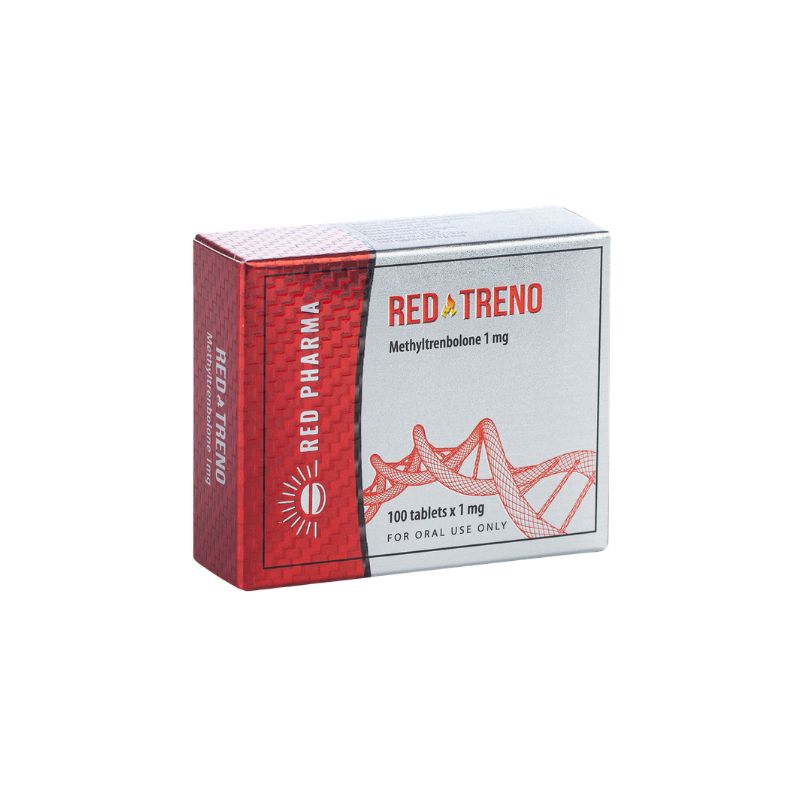 RED TRENO (Methyltrienolone 1 mg)
Methyltrienolone, code R1881, is 17β-hydroxy-17α-methylestra-4,9,11-trien-3-one. It is the compound that laboratory assays use when they need a known potent androgen to compare against, which is why the published record for it is deeper in some ways than for almost any medicine, and empty in others.
This page reports the measured numbers from the records cited here, and labels the evidence type for each one. Read the labels: none of the six abstracts below describes administration of methyltrienolone to a person.
The binding constant, from a fish receptor
The 2004 Environmental Science and Technology paper cloned and expressed the androgen receptor of the fathead minnow, Pimephales promelas, and characterised it with saturation and competitive binding assays in COS monkey kidney cells. Saturation experiments with Scatchard analysis determined that the Kd of the fathead minnow receptor for the potent synthetic androgen R1881 was 1.8 nM, “which is comparable to that for the human AR in the same assay system.”
That is the number usually quoted for R1881 in receptor work, and the paper is careful about where it comes from: it is a Kd from a non-mammalian receptor expressed in an African green monkey kidney cell line, compared to the human receptor in the same system. Dihydrotestosterone and 11-ketotestosterone were also high-affinity ligands for that receptor.
It is not aromatised
A 1984 Journal of Steroid Biochemistry paper asked directly whether methyltrienolone is converted to an oestrogen. Three preparations were used: placental microsomes, and homogenates of rat hypothalamic tissue. With a placental microsome preparation, a 10-fold molar excess of methyltrienolone did not affect the aromatisation of testosterone — it did not compete with testosterone in that system, nor inhibit the aromatisation. The placental aromatase converted testosterone to oestrogens efficiently but did not convert [3H]methyltrienolone to oestrogenic phenolic products. Rat hypothalamic homogenates were also unable to aromatise methyltrienolone, although the same homogenates converted small quantities of testosterone to estradiol and 19-hydroxyandrostenedione to estrone.
So the “does not convert to oestrogen” property is a measured enzymatic finding, not a marketing line. The same paper is also the reason nothing downstream of an aromatisation step is attributable to this compound.
A binding protein that needs NAD+
The 1990 Endocrinology paper characterised the methyltrienolone binding protein of human placental cytosol. It was found to require a low molecular weight modulator for steroid binding activity, and purification showed that NAD+ is the endogenous substance responsible for activating it to a steroid-binding form. The hierarchy of potency of exogenously added nucleotides is printed: NADH greater than NAD+ = NADPH = NADP+.
Tissue distribution was specific. Binding activity was present in placenta and chorion and absent from amnion and umbilical cord, and rat, mouse and rabbit placenta do not contain the protein, which the authors suggest means it may be a species-specific protein.
Two cell and receptor studies
The 2018 Journal of Cellular Biochemistry paper is the most recent human-cell work cited here. Controlled ovarian hyperstimulation was performed in 20 normal women, mural granulosa-lutein cells were isolated, cultured and passaged, starved for 48 hours in charcoal-stripped serum, and then treated for 48 hours with R1881, the androgen-receptor blocker bicalutamide, the PI3K/AKT pathway blocker LY294002, or combinations. Readouts were AKT1, AKT2, AKT3 and AR by quantitative real-time PCR, plus total and phosphorylated AKT by Western blot.
R1881 produced high expression of AKT1, AKT2 and AKT3 (P ≤ 0.05 against the LY294002 and bicalutamide groups), and AKT1 and AKT2 were decreased under bicalutamide or LY294002. AR, total AKT and phosphorylated AKT showed no significant differences between groups. The authors’ conclusion is that exposure with R1881 could affect AKT expression in these cells but cannot promote AR expression and AKT activation. That is a null result on the receptor pathway itself, in cells, in a laboratory dish.
The 1985 muscle paper is rat tissue. Male hypophysectomised rats received seven daily subcutaneous injections of cortisone acetate at 100 mg × kg-1 body weight or vehicle. Both [3H]dexamethasone and [3H]methyltrienolone receptor concentrations were decreased from vehicle values by more than 90% and 80% respectively. Scatchard analysis of [3H]methyltrienolone binding became nonlinear at high ligand concentrations and was reanalyzed with a two-component model; the lower-affinity, higher-capacity component, attributed to binding at a “dexamethasone” component, disappeared in the cortisone-treated rats.
Why the reference ligand is trenbolone-adjacent
The 2002 Toxicological Sciences paper on 17β-trenbolone explains why R1881 is the yardstick in the first place: it competed against 1 nM [3H]R1881 to give an IC50 of about 4 nM in rat ventral prostate cytosol and about 33 nM in cells transfected with the human androgen receptor. Trenbolone induced androgen-receptor-dependent gene expression in MDA-kb2 cells with a potency equal to or greater than dihydrotestosterone, and in immunocytochemistry with the human receptor, concentrations as low as 1 pM significantly induced nuclear translocation. In the Hershberger assay it was as potent as testosterone propionate in tissues lacking 5α-reductase and less effective in tissues that have the enzyme. Subcutaneous treatment was about 50- to 100-fold more effective than oral treatment in stimulating androgen-dependent tissue growth.
The last sentence is a ratio in rats, and it is the only route comparison in any abstract cited on this page.
What the data do not show
They do not show a human administration trial of methyltrienolone. The six records above are in vitro enzyme work, a non-mammalian receptor expressed in a monkey cell line, human placental cytosol, cultured human granulosa-lutein cells, rat muscle cytosol, and rat and cell-based assays in which R1881 is the ligand being competed against.
They do not show a body-composition, strength, lean-mass or bodyweight outcome in people, because none was measured in anyone.
They do not show an androgen effect that is not androgen-receptor-mediated, and they do not show a receptor-independent action, because the 2018 cell study found no change in AR expression or AKT activation.
They do not show a human route comparison. The 50- to 100-fold oral-versus-subcutaneous figure is from the rat Hershberger assay.
Where this sits on the shelf
The compound as supplied by the manufacturer: the methyltrienolone 1 mg presentation
What we supply
The methyltrienolone preparation above, as supplied by the manufacturer, tracked, from inside the EU.
Research use only. This page summarises published studies for research reference. It is not medical advice, not a protocol, and not a suggestion for human use. Nothing we supply is for human or veterinary use.
References.
- Doering CH, Leyra PT. Methyltrienolone (R1881) is not aromatized by placental microsomes or rat hypothalamic homogenates. J Steroid Biochem 1984;20(5):1157-62.
- Nekoonam S, Naji M, Mortezaee K, Amidi F. Roles of methyltrienolone (R1881) in AKTs and AR expression patterns of cultured granulosa-lutein cells. J Cell Biochem 2018;119(9):7204-7211.
- Macaulay JO, Warne GL, Smith AI, Krozowski ZS. The methyltrienolone binding protein of human placenta requires nicotinamide adenine dinucleotide cofactor(s) for steroid binding. Endocrinology 1990;126(5):2506-13.
- Kurowski TT, Capaccio JA, Chatterton RT Jr, Hickson RC. Depletion of [3H]methyltrienolone cytosol binding in glucocorticoid-induced muscle atrophy. Proc Soc Exp Biol Med 1985;178(2):215-21.
- Wilson VS, Cardon MC, Thornton J, et al. Cloning and in vitro expression and characterization of the androgen receptor and isolation of estrogen receptor alpha from the fathead Minnow (Pimephales promelas). Environ Sci Technol 2004;38(23):6314-21.
- Wilson VS, Lambright C, Ostby J, Gray LE Jr. In vitro and in vivo effects of 17beta-trenbolone: a feedlot effluent contaminant. Toxicol Sci 2002;70(2):202-11.