
Mifepristone: two receptors, and failed indications
Mifepristone blocks the progesterone receptor and the glucocorticoid receptor. It is an approved medicine for early medication abortion and, in one form, for Cushing's syndrome with impaired glucose metabolism. This page reads the trials behind both, and what the numbers actually were.
12 October 2026 · 5 min read
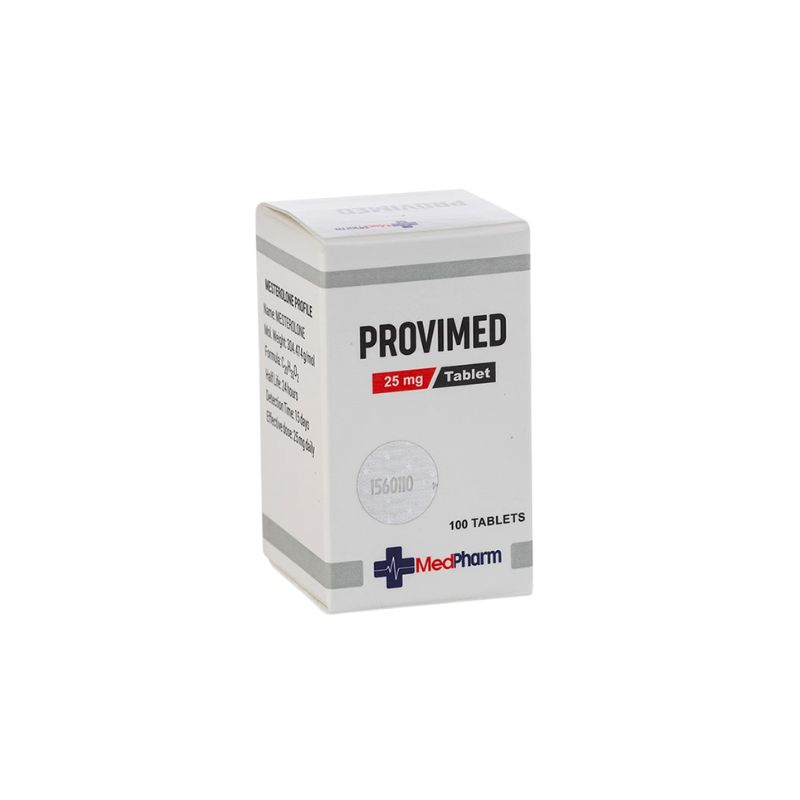 Provimed 25 mg (Mifepristone – Tablets)
Mifepristone is unusual on this shelf because it is not a research compound in name at all. It is an approved steroid with a marketing authorisation, two distinct pharmacological targets, and a regulatory history that includes a long list of indications that were proposed, studied and then not approved. Understanding it means separating the two receptors, because almost every surprise in its history comes from which one a study was actually about.
The two receptors
The antiprogestin action is the older half. Mifepristone competes at the progesterone receptor, and since progesterone is what maintains the uterine lining and the pregnancy, that block is what makes early medication abortion work when it is followed by misoprostol. A 2001 Annals of Pharmacotherapy review describes the combination as effective in 92-95% of women up to 49 days of amenorrhoea, with incomplete abortion requiring surgical completion in 3-5% and continued pregnancy in 1-2%.
The second receptor is the one that makes the compound interesting outside obstetrics. It is a glucocorticoid receptor antagonist. A 2015 Endocrine Reviews article on Cushing’s disease puts it in the adrenal-directed group of medical therapies and describes it as “highly effective in controlling clinical comorbidities, mainly glucose intolerance” — which is why it is the drug for Cushing’s syndrome specifically when that syndrome comes with impaired glucose metabolism and there is no surgical indication.
That same 2015 review is also a map of what has been tried and failed around it. Pituitary surgery is first-line for Cushing’s disease, with disease remission in around 78% and relapse in around 13% over ten years. Radiotherapy and adrenal surgery carry their own costs. The point of the review is that mifepristone is one tool in that sequence, not a solution to it.
The randomised evidence, dose by dose
The second-trimester trial from Obstetrics & Gynecology in 2007 is a clean one to read, because it is randomised, double-blind and placebo-controlled with a time-based endpoint. Sixty-four women seeking abortion between 18 and 23 weeks were enrolled. At the time of digoxin amnioinfusion each received an identical-appearing capsule containing either mifepristone 200 mg or placebo; all returned the next day for induction with buccal misoprostol.
Median procedure time was 10 hours with mifepristone (95% CI 8-12) against 18 hours with placebo (95% CI 15-22), p<0.01. Within the placebo group, parous women took 10 hours (95% CI 9-14) and nulliparous women 16 hours (95% CI 12-22, p=.02) — which is a useful control, because parity on its own predicted most of the difference. Secondary outcomes did not separate: placental retention 3.1% against 6.3% (p=.61), length of hospitalisation 0.66 days against 0.8 days (p=.23), analgesic requirements 27.2 mg against 39.3 mg morphine (p=.22). Side effects during induction were similar.
The 2024 New England Journal of Medicine trial is the most recent large randomised study indexed here, and it is not about the drug’s other receptor at all — it is about timing. Fifteen hundred and four women at up to 42 days of gestation, with an unconfirmed intrauterine pregnancy on ultrasound, were randomised to start the abortion immediately or to wait for the pregnancy to be confirmed on scan. Complete abortion occurred in 95.2% of the early-start group and 95.3% of the standard group; the difference was -0.1 percentage points against a 3.0-point non-inferiority margin. Ectopic pregnancies occurred in 1.3% and 0.8%, with one rupture before diagnosis in the early-start group, and serious adverse events in 1.6% against 0.7% (p=0.10).
The safety text, read properly
The 2001 review is blunt in a way later summaries are not, and it is worth reproducing rather than paraphrasing. Mifepristone with misoprostol “is not without significant risks, including hemorrhage, infection, and potential for long-term emotional consequences.” Incomplete abortion, endometritis, and bleeding warranting transfusion, hospitalisation or surgery occur commonly enough to be named. The compound is metabolised by the cytochrome P450 system, so drug interactions exist, and in 2001 that had not been well studied.
It is also worth being clear about what a trial of this drug can and cannot tell you. Every efficacy number on this page came from a regulated indication with a defined population, a defined gestational context and a clinical care pathway around it. None of them transfers to any other use, which is the entire reason this page exists and the reason it stops where it stops.
What the data do not show
They do not show a performance effect, a body-composition effect or a muscle effect. There is no such dataset in the citations above, and mifepristone is not a steroid androgen: it blocks two receptors rather than activating one. Its presence on a page of this kind is a fact about its pharmacology, not an indication of anything else.
They do not show that the early-abortion efficacy figures apply to the glucocorticoid indication, or the reverse. The Cushing’s evidence quoted here is a review of where the drug sits in a treatment algorithm, not a new trial of this page, and no effect size is quoted from it.
They do not show a profile for an unregulated use. The numbers above were produced in trials with protocolised dosing, administration by trained staff and follow-up built into the design — ectopic pregnancy and incomplete abortion are precisely the events that a follow-up visit is there to catch. A number lifted out of that setting and put on a shelf is a number that has lost the conditions that made it true.
They do not show an approved cancer indication, and the history here is the reason: this is one of the molecules for which the list of investigated indications is much longer than the list of approved ones. A 1993 British Medical Bulletin review on emergency contraception already listed it among the newer compounds tested, which is a reminder of how long the investigation history runs and how few of the branches of it ended in an authorisation.
Where this sits on the shelf
The compound as supplied by the manufacturer: Provimed 25 mg (Mifepristone)
What we supply
The mifepristone preparation above, as supplied by the manufacturer, tracked, from inside the EU.
Research use only. This page summarises published studies for research reference. It is not medical advice, not a protocol, and not a suggestion for human use. Nothing we supply is for human or veterinary use.
References.
- Kapp N, Borgatta LL, Stubblefield P, Vragovic O, Moreno N. Mifepristone in second-trimester medical abortion: a randomized controlled trial. Obstet Gynecol 2007;110(6):1304-1310.
- Brandell K, Jar-Allah T, et al. Randomized Trial of Very Early Medication Abortion. N Engl J Med 2024;391(18):1685-1695.
- DeHart RM, Morehead MS. Mifepristone. Ann Pharmacother 2001;35(6):707-719.
- Pivonello R, De Leo M, Cozzolino A, Colao A. The Treatment of Cushing's Disease. Endocr Rev 2015;36(4):385-486.
- Van Look PF, von Hertzen H. Emergency contraception. Br Med Bull 1993;49(1):158-170.


