Tadalafil oral strips: what the film studies measured
A tadalafil film and a tadalafil tablet are bioequivalent — that is exactly what two head-to-head pharmacokinetic studies found, in 36 and in 40 healthy men. The convenience argument is real; the faster-onset argument is not supported by those studies.
3 November 2026 · 4 min read
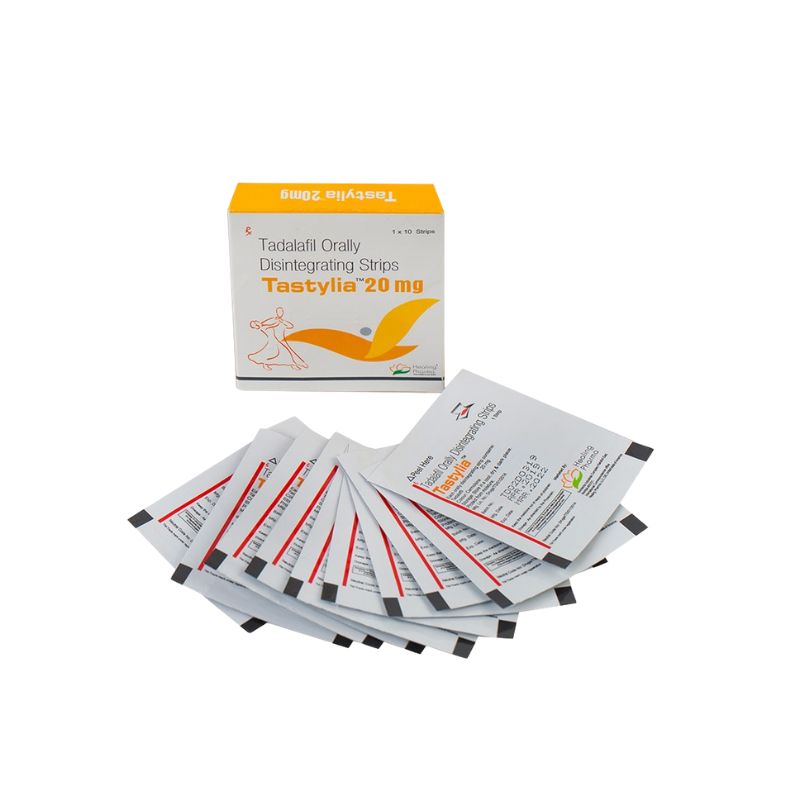 Tastylia 20 mg (Tadalafil – Oral Strips)
The oral strip is sold on two arguments: it is easier to take than a tablet, and it works faster. The first is obvious and true. The second is the one the head-to-head studies were designed to test, and they did not confirm it. The preparation discussed here is Tastylia 20 mg, the tadalafil oral strip, which sits in this catalogue next to the film-coated tadalafil and tadalafil 40 mg tablets.
The 2018 crossover: film against tablet, 40 men
The clearest study is the 2018 head-to-head by Park and colleagues in Drug Design, Development and Therapy. It used an open-label, randomised sequence, two-period, two-formulation, single-dose crossover design in healthy male subjects, with both the test orodispersible film and the reference film-coated tablet containing 20 mg of tadalafil. Blood samples were collected up to 72 hours, plasma tadalafil was measured by liquid chromatography-tandem mass spectrometry, and the comparison was made as geometric mean ratios with 90 % confidence intervals.
Forty men were enrolled and 36 completed the study. The results:
- Maximum plasma concentration, film to tablet: 0.927 (0.882–0.974)
- AUC from zero to last quantifiable concentration: 0.972 (0.918–1.029)
Both formulations were well tolerated, with no clinically significant changes from baseline. The authors’ conclusion is unambiguous: the pharmacokinetics of the orodispersible film “did not differ significantly from those of the film-coated tablet”, and the safety and tolerability profiles were comparable. Their framing is that the film “offers a convenient treatment option”.
Read the Cmax ratio carefully rather than skimming it. The film produced a maximum plasma concentration slightly below the tablet — a ratio below 1, with the confidence interval excluding 1. If the strip produced a meaningfully earlier or larger peak, this is not what the numbers show.
The 2025 bioequivalence study: with water, without water
The second study, published in Clinical and Translational Science in 2025, is a bioequivalence design rather than a mechanistic one. Thirty-six healthy Chinese male volunteers were randomised into three sequences, and in each period received one tadalafil tablet, one tadalafil oral soluble film taken with water, or one film taken without water, all at 10 mg, under fasting conditions.
The 90 % confidence intervals of the geometric mean ratios for the primary pharmacokinetic parameters — Cmax, AUC0-t and AUC0-∞ — all fell inside the standard bioequivalence range of 80.00 % to 125.00 %. Adverse events were mild or moderate, no serious adverse events were reported, and all formulations were well tolerated.
Two things follow. The film is bioequivalent to the tablet. And the film taken with water was bioequivalent to the film taken without it — which is a result about the water, not about the film, and it quietly undercuts the “no water needed” framing that is sometimes used to imply a different absorption route.
What the reviews say about onset
The 2019 review by Zucchi and colleagues in Andrology analysed why patients stop PDE5 inhibitors on demand, and it names the reason directly: dissatisfaction comes “from the relatively long Tonset after taking vardenafil and sildenafil, including formulations such as film-coated tablets, fine granules, orally disintegrating tablets (ODTs), and oral thin films (ODFs)”. Onset is treated here as a real problem, and eating makes it worse.
But the same review is careful about the fix. It notes that some data suggest sildenafil is a “difficult” molecule whose onset can be improved by absorption through the buccal mucosa with appropriate excipients, and its conclusion on the ODT and ODF formats is that they improve the discretion problem — being taken without water — while having similar pharmacokinetics. Convenience, not speed.
The 2014 systematic review of mirodenafil by Park and colleagues describes the same development in the Korean market: a drug launched in 2007, and “an orally disintegrating film of mirodenafil was developed in 2011 for benefitting patients having difficulty in swallowing tablets”. That is the design intent stated in the literature — swallowing difficulty, not onset.
What the data do not show
- No head-to-head study shows the tadalafil strip beats the tablet on onset. The two PK studies above report a film Cmax ratio of 0.927 and an AUC ratio of 0.972 — equivalence, not superiority.
- No efficacy trial of a tadalafil film reports IELT against a placebo tablet comparator. These are pharmacokinetic and bioequivalence studies; they measure how much and how fast, not what happened afterwards.
- “Works without water” is a convenience finding, and the 2025 study found the film behaved the same with and without water.
- The onset critique is about PDE5 inhibitors as a class, and the reviews that document it do not single out strips as the solution.
- Nothing here is a dosing recommendation. The milligram figures are the strengths those studies administered; nothing on this page says what any person should take, and nothing supplied here is a treatment for a diagnosed condition.
For the comparison that actually ranks the members of this class by their pharmacokinetics rather than by their marketing, see sildenafil against tadalafil.
References.
- Park SI, Heo SH, Kim G, et al. Comparison of tadalafil pharmacokinetics after administration of a new orodispersible film versus a film-coated tablet. Drug Des Devel Ther 2018;12:935-942 (PMID 29719379).
- Jiang X, Sun F, Shi P, et al. Bioequivalence study of tadalafil oral soluble film and tadalafil tablet in healthy Chinese volunteers under fasting conditions. Clin Transl Sci 2025;18(12):e70440 (PMID 41340316).
- Zucchi A, Costantini E, Scroppo FI, et al. The first-generation phosphodiesterase 5 inhibitors and their pharmacokinetic issue. Andrology 2019;7(6):804-817 (PMID 31350821).
- Park HJ, Moon KH, Lee SW, et al. Mirodenafil for the treatment of erectile dysfunction: a systematic review of the literature. World J Mens Health 2014;32(1):18-27 (PMID 24872948).