Turinabol: the only controlled human study measures urine, not effects
Dehydrochloromethyltestosterone was administered to five healthy volunteers at 5 mg and followed for 60 days, and the paper's purpose was anti-doping detection: identifying long-term urinary metabolites, one of them detectable 45 days out. This page reads the human record that exists and is clear about the record that does not.
20 October 2026 · 3 min read
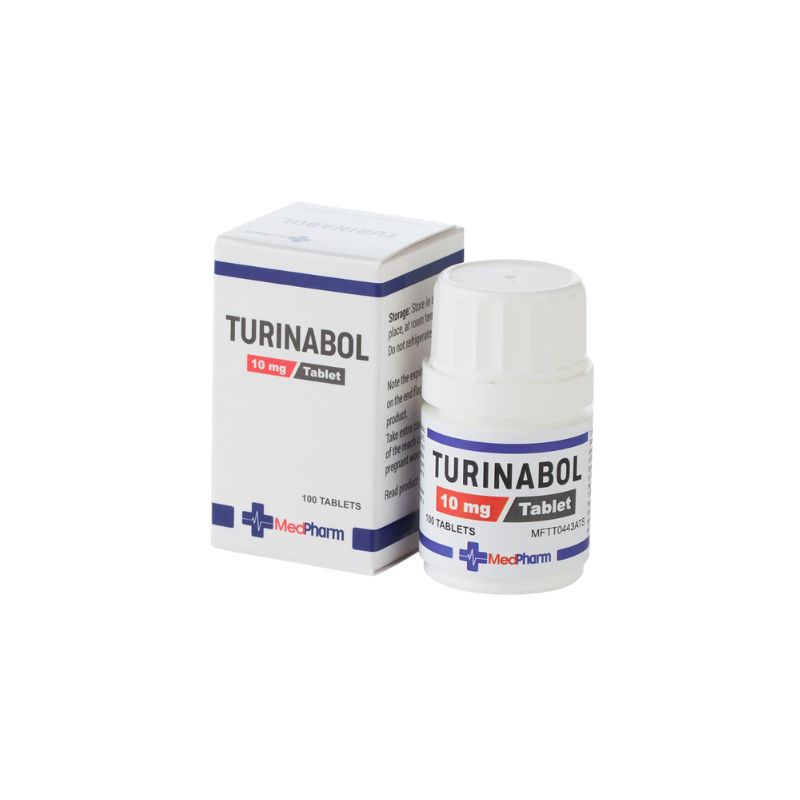 Turinabol 10 mg (Chlorodehydromethyltestosterone – Tablets)
Turinabol — 4-chloro-17alpha-methyl-17beta-hydroxy-1,4-androstadien-3-one, sold as Oral Turinabol and known in anti-doping work as dehydrochloromethyltestosterone or DHCMT — has a peculiar literature. The metabolic and forensic side is well developed. The human effects side is, on the published record cited here, empty.
The one controlled administration study in humans
The 2021 paper from the Freie Universität Berlin group, written with two anti-doping laboratories, is the reference study, and its stated purpose tells you what kind of paper it is: urinary excretion and long-term detection of metabolites for anti-doping purposes.
DHCMT was developed by Jenapharm in the 1960s and marketed as Oral Turinabol. It is prohibited in sports at all times; nevertheless, anti-doping laboratories find it every year. Long-term metabolites had been proposed in 2011 and 2012, producing adverse analytical findings in retests of the 2008 and 2012 Olympic games — but no controlled administration trial monitoring those long-term metabolites had been reported. In this study, DHCMT at 5 mg orally was administered to five healthy male volunteers and their urine samples were collected for a total of 60 days.
The findings are all analytical. The formation of the described long-term metabolites was verified and their excretion monitored in detail. The metabolite M3, with a fully reduced A-ring and modified D-ring structure, was identified by comparison with reference material as 4alpha-chloro-17beta-hydroxymethyl-17alpha-methyl-18-nor-5alpha-androstan-13-en-3alpha-ol, and found suitable as a long-term marker in four of the five volunteers; in one volunteer it was detectable for 45 days after a single oral dose. In two volunteers M5, published as a long-term metabolite in the 1990s, showed longer detection windows. In one volunteer M3 was undetectable and another metabolite, M2, was the longest detectable. The last sample clearly identified as positive was collected between 9.9 and 44.9 days.
The interindividual variety in those profiles is itself the result: the paper attributes it to interindividual differences.
Five volunteers, one 5 mg dose, sixty days of urine, zero efficacy or safety endpoints.
The metabolism context
The companion 2021 paper from the same group explains why the Turinabol work matters methodologically. Following the detection of long-term metabolites with a 17xi-hydroxymethyl-17xi-methyl-18-nor-5xi-androst-13-en-3xi-ol structure in the chlorinated metandienone analogue dehydrochloromethyltestosterone, they investigated the formation of similar metabolites in metandienone and 17alpha-methyltestosterone, using a semi-targeted approach that included synthesising reference compounds.
Two diastereomeric substances were identified after methyltestosterone administration. In post-administration urines of metandienone, only the 5beta-metabolite was detected, and 3alpha,5beta-tetrahydro-epi-methyltestosterone was identified in the urines of both administrations beside the classical metabolites included in screening procedures.
And the third paper is the clearest illustration of how the compound is researched: the metabolic studies of turinabol in horses. In vitro, the compound was incubated with fresh horse liver microsomes, and metabolism was hydroxylation at the C6, C16 and C20 sites giving 6beta-hydroxyturinabol, 20-hydroxyturinabol, two stereoisomers of 6beta,16-dihydroxyturinabol and 6beta,20-dihydroxyturinabol; 6beta-hydroxyturinabol was confirmed with an authentic reference standard, the rest tentatively identified by mass spectral interpretation. The objective was to identify the most appropriate target metabolites for detecting turinabol administration.
Three decades of good chemistry, and the human literature is an anti-doping file.
What the data do not show
They do not show an efficacy trial of Turinabol in humans. No randomised or controlled clinical outcome study appears in the sources cited on this page.
They do not show what a 5 mg dose does to a person over time. The 60-day window in the one human administration study was urine collection, not observation of effects.
They do not show a safety or tolerability profile. Five volunteers, one dose, no adverse event endpoints reported.
They do not show that the compound is benign because detection is sensitive. A long detection window is a forensic fact, and it says nothing about effects in either direction.
Where this sits on the shelf
The compound as supplied by the manufacturer: Turinabol 10 mg (Chlorodehydromethyltestosterone — Tablets)
What we supply
The Turinabol preparation above, as supplied by the manufacturer, tracked, from inside the EU.
Research use only. This page summarises published studies for research reference. It is not medical advice, not a protocol, and not a suggestion for human use. Nothing we supply is for human or veterinary use.
References.
- Loke S, et al. Controlled administration of dehydrochloromethyltestosterone in humans: Urinary excretion and long-term detection of metabolites for anti-doping purpose. J Steroid Biochem Mol Biol 2021;214:105978.
- Loke S, et al. New Insights into the Metabolism of Methyltestosterone and Metandienone: Detection of Novel A-Ring Reduced Metabolites. Molecules 2021;26(5):1354.
- Ho EN, et al. Metabolic studies of turinabol in horses. Anal Chim Acta 2007;586(1-2):208-216.