Vardenafil: effective, and ranked below sildenafil
Vardenafil reliably beats placebo on every domain of the IIEF. It also loses the direct comparisons: pooled IIEF improvement 7.50 points against sildenafil's 9.65, and a number needed to treat of 4.1 against 2.4 in the diabetic subgroup meta-analysis. Its one documented advantage is that it does not produce sildenafil's colour-vision effect.
17 October 2026 · 4 min read
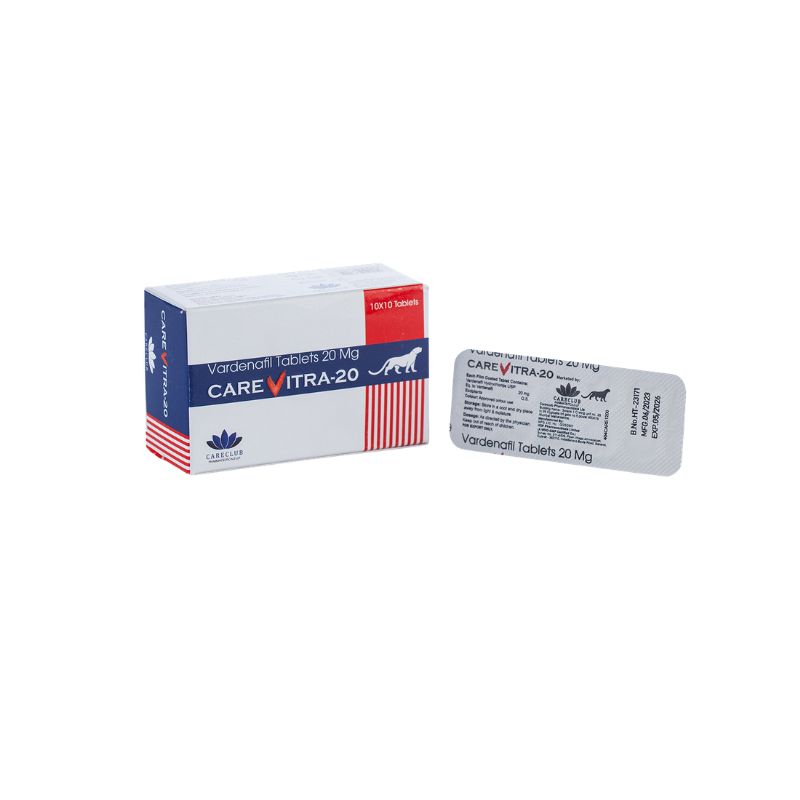 Carevitra-20 (Vardenafil 20 mg) 10 x10 Tablets
Vardenafil is the third oral phosphodiesterase type 5 inhibitor to reach the market, after sildenafil and before tadalafil, and it has stayed in the awkward middle position ever since. It works. Every pooled trial on this page finds it significantly better than placebo. It also loses the head-to-head comparisons, repeatedly, against the drug that came first.
The placebo evidence, which is not in dispute
The 2021 systematic review pooled 14 studies with 3,221 patients and walked every domain of the International Index of Erectile Function. Against placebo, vardenafil improved the erectile function domain by a weighted mean difference of 7.93 points (95% CI 6.00 to 9.85), intercourse satisfaction by 5.24 (95% CI 3.35 to 7.13), orgasmic function by 3.81 (95% CI 2.26 to 5.35), overall satisfaction by 3.37 (95% CI 2.02 to 4.71) and sexual desire by 0.79 (95% CI 0.24 to 1.35). Sexual Encounter Profile question 2 improved by 26.36 percentage points and question 3 by 35.18. The authors’ conclusion is that efficacy is significant and the optimal dose and course remain to be established.
The earlier 2004 meta-analysis of clinical trial reports is larger — nine trials, 6,809 men — and reports the erectile function domain rising 6.18 units over placebo, firm erections suitable for penetration up 26 points, successful attempts per participant up 29.8 points, and men agreeing their erections had improved at RR 3. It also reports the two costs: discontinuations higher than placebo at RR 2.25, and specific adverse events of flushing, dyspepsia, headache and rhinitis. On cardiovascular safety it states that vardenafil was not significantly associated with serious cardiovascular events or death.
That last sentence is from a 2004 analysis of trials that were not designed around cardiovascular outcomes. It is not a cardiovascular outcomes trial and should not be read as one.
Subgroups behave. In the 2007 meta-analysis restricted to hypertensive men, eight trials with 2,427 patients included 839 who self-reported hypertension. At week 12 the erectile function domain rose 8.9 points against placebo (95% CI 7.4 to 10.5), penetration success rose 32.4% (95% CI 27.4 to 37.5) and maintenance success rose 38.0% (95% CI 29.5 to 46.6) — and vardenafil was equally effective in men with and without hypertension.
Where it loses
The 2006 comparative meta-analysis of fixed-dose trials is the one that prints the ranking. Across 14 trials, the pooled IIEF improvement was 9.65 points (95% CI 8.50 to 10.79) for sildenafil, 8.52 (7.61 to 9.42) for tadalafil and 7.50 (6.50 to 8.50) for vardenafil. Sildenafil proved significantly more effective than vardenafil, d = 2.15, P = 0.006, while the other pairwise comparisons showed no difference. The authors add the caveat that has not aged well in anybody’s favour: to prove higher efficacy, truly independent comparative trials are needed.
The diabetes literature points the same way. In the 2015 meta-analysis of 17 studies in men with diabetes, the pooled effect size over placebo was 1.198 for sildenafil, 0.910 for tadalafil and 0.678 for vardenafil. Number needed to treat: 2.4 for sildenafil, 2.6 for tadalafil, 4.1 for vardenafil and 3.0 for any PDE5 inhibitor.
The 2005 trial comparison review phrases the trade in exactly one sentence: vardenafil is more potent and more selective than sildenafil at inhibiting PDE5, it is similarly effective, and the only advantage it has is that it does not inhibit PDE6 to alter colour perception — a rare sildenafil side effect. And the tolerability reviews on this page back that up: the adverse events reported for vardenafil at clinically recommended doses were headache, flushing, rhinitis, dyspepsia and sinusitis, with no reports of abnormal colour vision.
Food, and what it does to absorption
The 2003 pharmacokinetic study is a small clean experiment: 25 healthy men, single 20 mg dose, randomised four-way crossover. Taken after an overnight fast, geometric mean Cmax was 17.14 µg/L and AUC 66.78 µg·h/L; after a high-fat breakfast, Cmax 14.0 µg/L and AUC 67.09 µg·h/L, with median Tmax slipping from 1 hour to 2 hours. Taken in the evening, fasting gave Cmax 14.22 and AUC 51.97; after a moderate-fat meal, Cmax 13.04 and AUC 59.12, with median Tmax at 1 hour in both.
The authors’ conclusion is the practical one: a high-fat meal may alter Cmax slightly and delay absorption by up to an hour, a moderate-fat meal has no clinically relevant effect, and no dose adjustment is warranted. That is a real difference from sildenafil, whose absorption is genuinely food-dependent.
What the data do not show
They do not show vardenafil winning a head-to-head comparison against sildenafil on erectile function. Every direct synthesis on this page puts it behind.
They do not show a cardiovascular outcome. The trials measured erectile function domains and sexual encounter profiles; none was designed to answer what these drugs do to a heart.
They do not show a colour-vision advantage in any measured way. The absence of abnormal colour vision reports is a tolerability observation across trials, not a comparative study, and the same reviews record headache, flushing, rhinitis and dyspepsia as the common adverse events.
Where this sits on the shelf
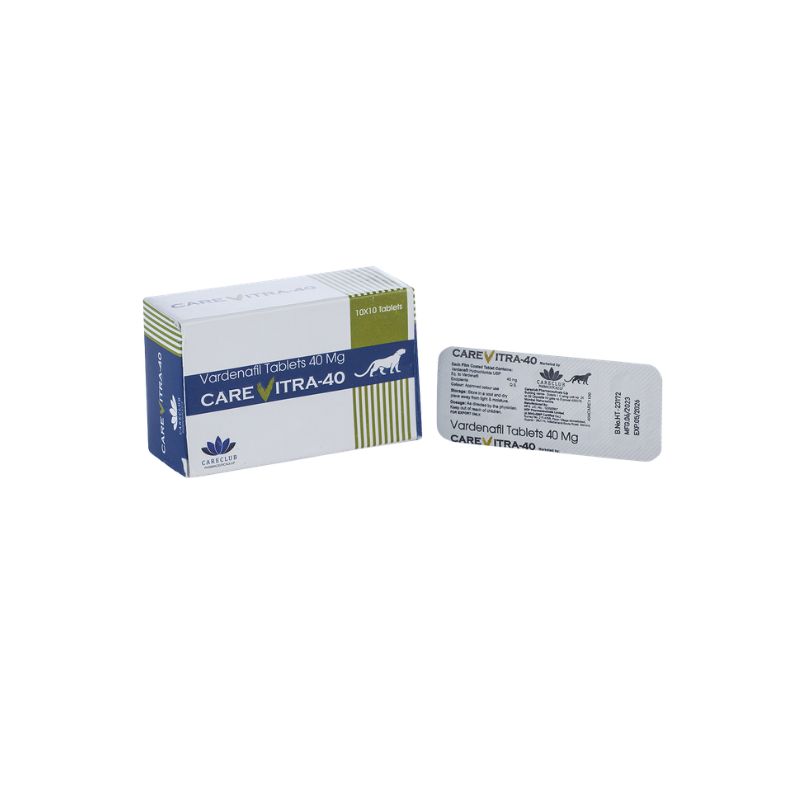
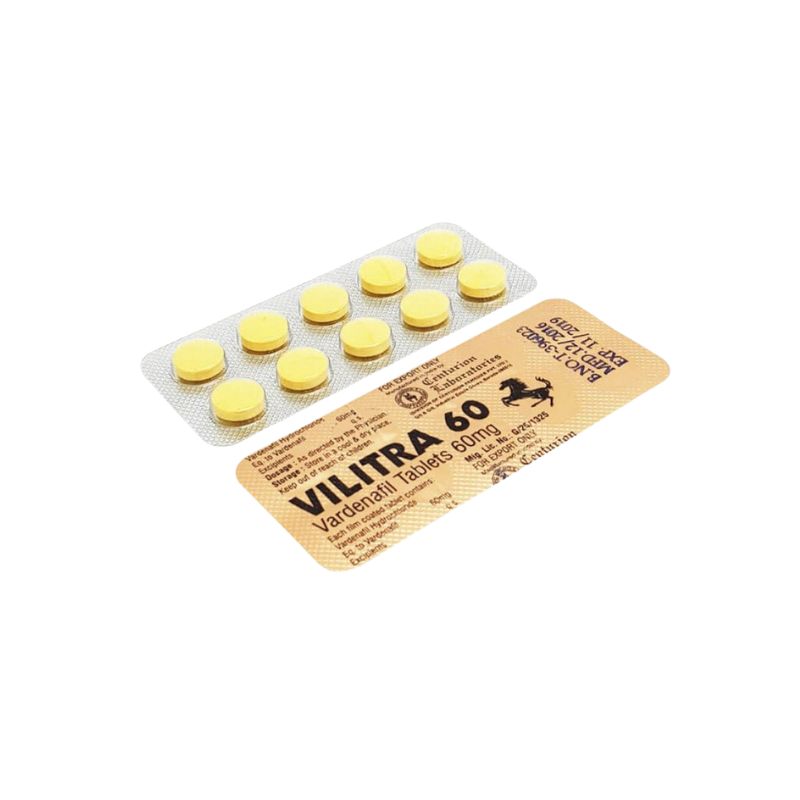
The compounds as supplied by the manufacturer: Carevitra 20 (Vardenafil 20 mg) · Carevitra 40 (Vardenafil 40 mg) · Vilitra 60 (Vardenafil 60 mg)
What we supply
The vardenafil preparations above, as supplied by the manufacturer, tracked, from inside the EU.
Research use only. This page summarises published studies for research reference. It is not medical advice, not a protocol, and not a suggestion for human use. Nothing we supply is for human or veterinary use.
References.
- Wang H, et al. Vardenafil in the Treatment of Male Erectile Dysfunction: A Systematic Review and Meta-Analysis. Adv Ther 2021;38(2):1301-1313.
- Markou S, et al. Vardenafil (Levitra) for erectile dysfunction: a systematic review and meta-analysis of clinical trial reports. Int J Impot Res 2004;16(6):470-478.
- Shabsigh R, et al. Efficacy of vardenafil for the treatment of erectile dysfunction in men with hypertension: a meta-analysis of clinical trial data. Curr Med Res Opin 2007;23(10):2453-2460.
- Berner MM, et al. Efficacy of PDE-5-inhibitors for erectile dysfunction. A comparative meta-analysis of fixed-dose regimen randomized controlled trials. Int J Impot Res 2006;18(3):229-235.
- Balhara YP, et al. Phosphodiesterase-5 inhibitors for erectile dysfunction in patients with diabetes mellitus: A systematic review and meta-analysis of randomized controlled trials. Indian J Endocrinol Metab 2015;19(4):451-461.
- Doggrell SA. Comparison of clinical trials with sildenafil, vardenafil and tadalafil in erectile dysfunction. Expert Opin Pharmacother 2005;6(1):75-84.
- Keating GM. Spotlight on vardenafil in erectile dysfunction. Drugs Aging 2004;21:135-140.
- Rajagopalan P, et al. Effect of high-fat breakfast and moderate-fat evening meal on the pharmacokinetics of vardenafil. J Clin Pharmacol 2003;43(3):260-267.