CJC-1295 without DAC: what the studies describe, and what the name hides
CJC-1295 comes in two pharmaceutical forms that are not interchangeable — one with a drug affinity complex that extends its half-life, one without that does not. The human proteomics work in this file used the DAC form, and the two are routinely sold and read as the same thing.
13 November 2026 · 4 min read
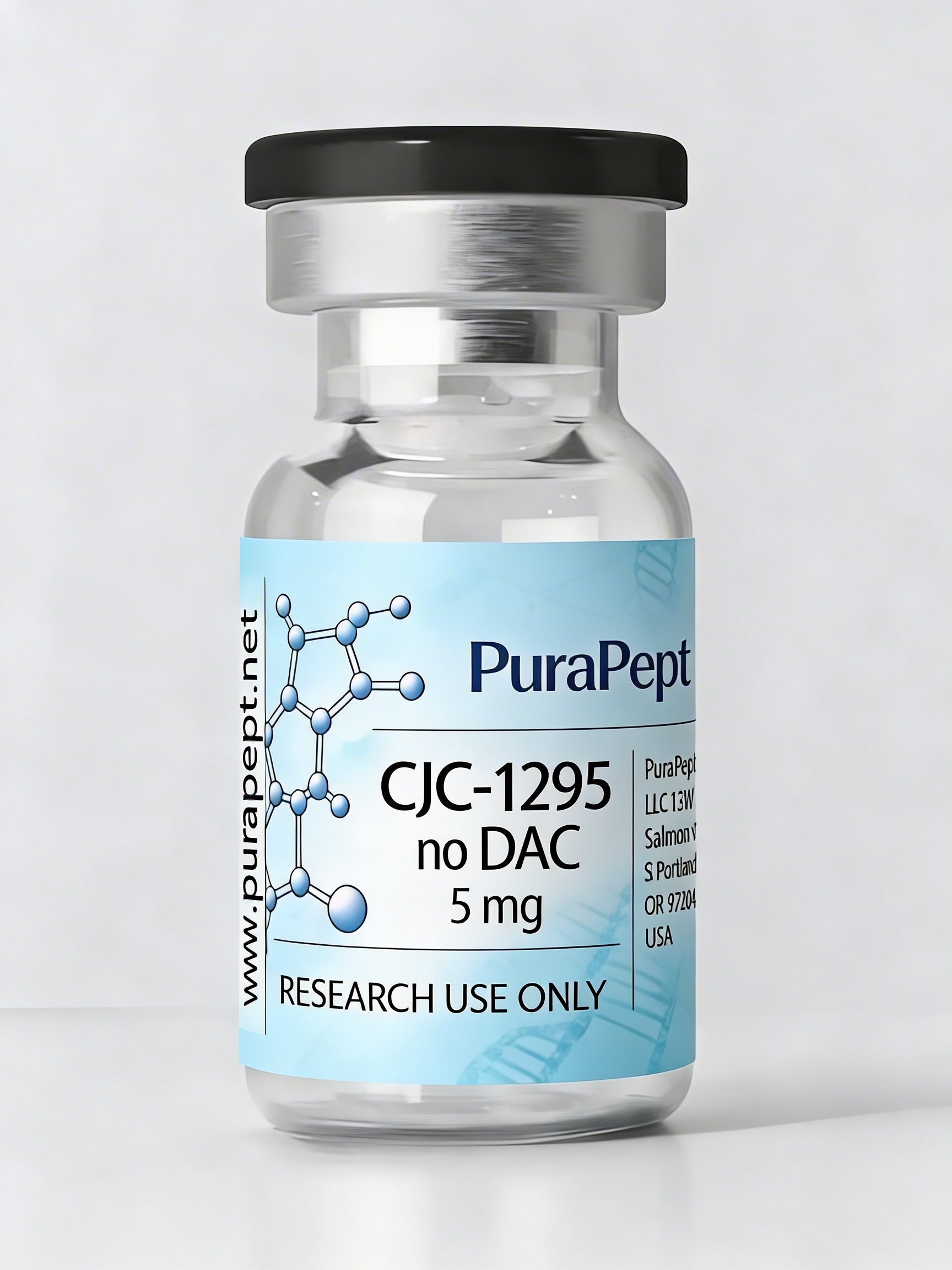 CJC-1295 no DAC 5 mg
CJC-1295 no DAC belongs to a family where the single most important fact is in the name. CJC-1295 is a growth-hormone-releasing hormone analogue. Two pharmaceutical presentations exist: one conjugated to a drug affinity complex that extends its half-life dramatically, and one without. Almost every human study in the literature — including the one below — used the DAC form. This page is about what that gap means for the product on this page.
What the studies actually describe
The clearest human dataset is a 2009 proteomics paper from the group that characterised the compound. Its stated purpose is identifying biomarkers of growth hormone and IGF-1 action in human serum, motivated by the observation that the current biomarkers — IGF-1, IGFBP-3 and collagen peptides — show substantial variability in the population, and are not reliably predictive of either the physiologic effects of GH therapy or the detection of GH abuse by athletes.
That framing is worth pausing on. The paper is a biomarker-discovery study, and its authors name the detection-of-abuse use case explicitly. What it did: sera from 11 healthy young adult men before and one week after a CJC-1295 injection, analysed by two-dimensional gel electrophoresis, with significantly changing spots identified by mass spectrometry. Two spots that decreased were identified as an apolipoprotein A1 isoform and a transthyretin isoform; three spots that increased included beta-hemoglobin, a C-terminal fragment of albumin, and a mix of an immunoglobulin fragment and another C-terminal albumin fragment. A linear relationship was found between the spot containing immunoglobulin and albumin fragments and IGF-1 levels.
The paper’s own conclusion is appropriately hedged: although the molecular mechanisms linking the identified proteins to GH and IGF-1 biological activity remain to be clarified, the results suggest they represent potential biomarkers of GH and/or IGF-1 action.
So the human file on CJC-1295 is eleven men, one injection, one week, and a set of serum protein spots. That is the size of it, and it is a genuinely useful scientific paper that answers a biomarker question rather than a body-composition one.
How the current clinical literature describes the whole class
A 2025 narrative review in Frontiers in Endocrinology is the most direct modern account of where these peptides sit between evidence and practice. It notes that performance-enhancing drugs marketed as “research compounds” include unregulated peptides intended to modulate the GH-IGF-1 axis, and that the agents most commonly encountered in clinical practice and online self-administration protocols include GHRH analogues — naming sermorelin, tesamorelin, CJC-1295 with DAC, and CJC-1295 without DAC as a separate entry — alongside growth hormone secretagogues (GHRP-2, GHRP-6, hexarelin, ipamorelin), the growth hormone fragment AOD9604, and IGF-1 analogues including PEG-MGF and IGF-1 Long R3.
Its reported adverse effects span endocrine and metabolic disturbances including prolactin and cortisol elevations, appetite changes and dysglycaemia; fluid retention syndromes; musculoskeletal symptoms; and injection-site reactions. And its central methodological point is the one that matters for this page: given the absence of regulatory approval for physique- or performance-related indications and the uncertainty surrounding product composition, dose, and stacking practices in unregulated supply chains, clinicians need a pragmatic framework to interpret symptoms and laboratory abnormalities. The review stratifies peptides into evidence tiers from regulatory-grade randomized trial data to a complete absence of human studies, and highlights the resulting uncertainty around putative performance and recomposition benefits.
Two 2026 reviews frame the same class from the orthopaedic and endocrine sides. Both describe the mechanism — GHRH analogues and secretagogues activating IGF-1 signalling — and both attach the same caveat. The orthopaedic review states that although preclinical studies are promising, there is a current lack of clinical trials, and covers wound-healing peptides and recovery agents in the same breath. The endocrine review, covering 106 articles, concludes that therapeutic peptides are a promising tool for type 2 diabetes and obesity, skin rejuvenation and hormone analogues, but that further studies are needed before most new peptides can be used safely in humans.
The DAC distinction, stated plainly
None of the three reviews above resolves which CJC-1295 was used in which trial, and that is the problem. The two forms differ in exactly the property that governs how long a given amount stays in the body: the DAC form is a modified release, the non-DAC form is not. Findings about GH and IGF-1 response from the DAC form are not transferable to the non-DAC form without a pharmacokinetic argument, and the proteomics study above does not make one — it reports one week after one injection of the long-acting form.
Two independent store pages cover the two forms separately, because they are separate molecules in practice, and the only defensible position on a page about the non-DAC form is to say that the human biomarker work quoted here was not done on it.
What this record does not show
Not a body-composition result. The human paper measured serum protein spots, not lean mass, fat mass or strength.
Not a study of the non-DAC form. The proteomics work used the long-acting DAC presentation.
Not a claim that the mechanism does not apply. The GHRH receptor biology is the same. What is missing is pharmacokinetic transfer.
Not an approval. The 2025 review states the absence of regulatory approval for physique- or performance-related indications, and the 2026 reviews state that most of these peptides have not been studied for safe human use.
What we supply
CJC-1295 no DAC, as supplied by the manufacturer, tracked, from inside the EU. Batch documentation for any product that carries it is explained in the COA guide linked from the product page.
The most valuable thing in this file is a review that sorts compounds into evidence tiers and admits that the lowest tier is empty. Research use only. This page summarises published proteomic and clinical literature for research reference. It is not medical advice and not a suggestion for human use. Nothing we supply is for human or veterinary use.
References.
- Sackmann-Sala L, Ding J, Frohman LA, Kopchick JJ. Activation of the GH/IGF-1 axis by CJC-1295, a long-acting GHRH analog, results in serum protein profile changes in normal adult subjects. Growth Horm IGF Res 2009;19(6):471-477 (PMID 19386527).
- Dominikowski A, Rękoś Z, Olejarz M, Szczepanek-Parulska E, Domin R, Ruchała M. The emerging landscape of performance-enhancing peptides modulating GH-IGF1 axis: bridging the gap between clinical evidence and patient self-administration. Front Endocrinol (Lausanne) 2026;17:1822475 (PMID 42395176).
- Rahman OF, Lee SJ, Seeds WA. Therapeutic peptides in orthopaedics: applications, challenges, and future directions. J Am Acad Orthop Surg Glob Res Rev 2026;10(1) (PMID 41490200).
- Renke G, Chinellato L. Therapeutic peptides in aesthetic, metabolic and endocrine conditions: effects, safety, clinical applications, and future perspectives. Int J Mol Sci 2026;27(9):3890 (PMID 42123471).