Ipamorelin: the selective secretagogue, and what the selectivity is for
Ipamorelin was designed to release growth hormone without the appetite effect that limits the other secretagogues. The animal work confirms exactly that, and the bone work contains a result worth reading twice: the bones got bigger, and their density did not change.
14 November 2026 · 4 min read
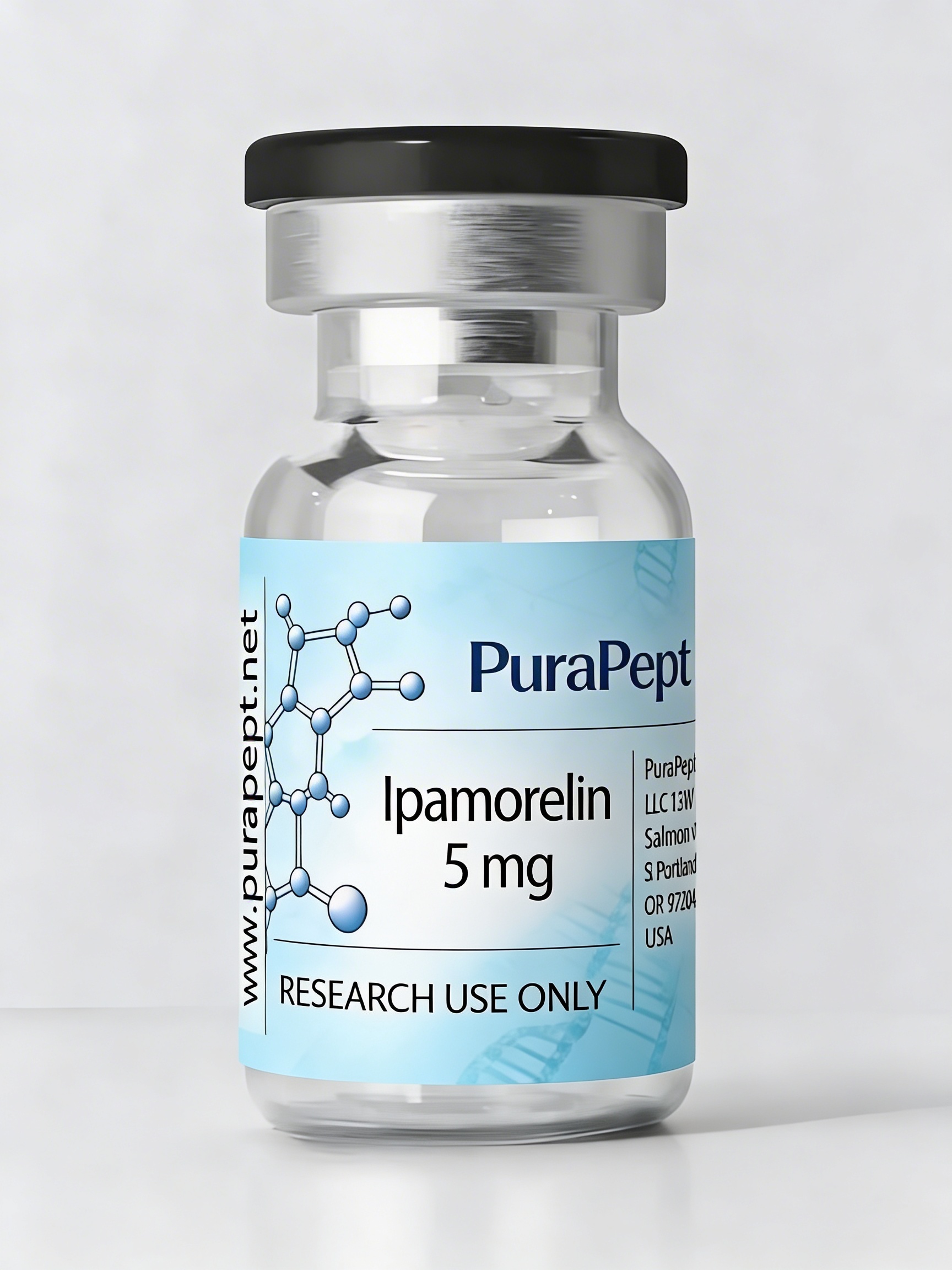 Ipamorelin 5 mg
Ipamorelin is the growth-hormone secretagogue with a specific design brief: release GH without raising appetite. That brief is met in the animal literature, and meeting it is the compound’s entire distinguishing claim. This page looks at what the selectivity buys, and at one bone result that is routinely quoted backwards.
What the selectivity claim is based on
Ghrelin and ghrelin mimetics stimulate appetite and enhance gastric motility, and ipamorelin is described in the animal literature as a selective growth hormone secretagogue and agonist of the ghrelin receptor. A 2009 study in the Journal of Pharmacology and Experimental Therapeutics used it as the clean case: fasted male rats underwent laparotomy and intestinal manipulation to create postoperative ileus, and were then given ipamorelin, GHRP-6, or vehicle, either as a single dose or as two days of repetitive dosing.
The result separates the two secretagogues cleanly. A single dose of either ipamorelin or GHRP-6 decreased the time to first bowel movement but had no effect on cumulative fecal output, food intake, or body weight gain measured 48 hours after surgery. In contrast, repetitive dosing of ipamorelin significantly increased cumulative fecal pellet output, food intake and body weight gain.
So the selectivity is a statement about a window, not a property. It held over a single administration in this model; over two days of repeated administration the food intake and weight gain followed. That is exactly the kind of result that is correct in the abstract and inverted in a forum, and the mechanism in the review below explains why it had to be so.
The class framing
A 2020 review in Translational andrology & urology places ipamorelin in context and is candid about the state of the field. It notes that male hypogonadism is increasingly prevalent, that obesity and metabolic syndrome can both cause and result from it, and that although testosterone remains the gold standard its benefits are not always conserved across different populations, especially with regards to changes in body composition. In response to that, growth hormone secretagogues have emerged as a potential novel adjunctive therapy for some of the symptoms of hypogonadism — although, in the review’s words, current data on their clinical efficacy largely remain lacking.
It covers sermorelin, GHRP-2, GHRP-6, ibutamoren and ipamorelin, and states that all are potent GH and IGF-1 stimulators that can significantly improve body composition while ameliorating specific hypogonadal symptoms including fat gain and muscular atrophy. But it closes the same way it opened: a paucity of data examining the clinical effects of these compounds limits understanding of their role in men with hypogonadism.
The 2025 GH-IGF-1 axis review is blunter still, and worth quoting because it is written about the real-world situation rather than the pharmacology. It places ipamorelin in the secretagogue group alongside GHRP-2, GHRP-6 and hexarelin, and states that given the absence of regulatory approval for physique- or performance-related indications and the uncertainty surrounding product composition, amount and stacking practices in unregulated supply chains, clinicians require a pragmatic framework to interpret symptoms and laboratory abnormalities. It stratifies compounds into evidence tiers from regulatory-grade randomized trial data to a complete absence of human studies.
The bone study, read properly
The 2000 Journal of Endocrinology paper is the most-cited ipamorelin study in the preclinical file and the one most often misread.
Thirteen-week-old female Sprague-Dawley rats received ipamorelin, GHRP-6, growth hormone, or vehicle continuously for 12 weeks, tracked by DXA every four weeks, with femurs and vertebrae analysed afterwards by pQCT, by Archimedes’ principle, and by ash weight.
Every treatment increased body weight and total tibial and vertebral bone mineral content by DXA. But the in-vitro analyses reframe what that means:
- Total bone mineral content corrected for body weight was unaffected.
- Tibial area bone mineral density increased; total and vertebral area densities were unchanged.
- The pQCT measurements showed the increase in cortical bone mineral content was due to an increased cross-sectional bone area, whereas cortical volumetric density was unchanged.
- Femur and vertebra volumes increased, with no effect on volumetric densities.
- Ash weight increased with all treatments, but mineral concentration was unchanged.
The authors’ conclusion: the increases in cortical and total bone mineral content were due to increased growth of the bones with increased bone dimensions, whereas the volumetric density was unchanged.
Read together, the study says the animals grew and their bones grew with them. That is not the same as the bones becoming more mineral-dense, and the two are routinely conflated in summaries that report “increased bone mineral density” from a study whose own conclusion is about bone size. It is also, incidentally, a useful general warning about DXA-based body-composition readouts in any growing or weight-changing subject.
What this record does not show
Not a human result. Every study on this page is in rats.
Not an absolute selectivity claim. The food-intake separation held after a single administration and did not hold after two days of repeated administration in the ileus model.
Not a bone-density finding. The study’s own conclusion is about bone dimensions, not volumetric density.
Not a clinical efficacy claim. The 2020 review states the clinical data on secretagogues largely remain lacking; the 2025 review places this class in evidence tiers that run down to an absence of human studies.
What we supply
Ipamorelin, as supplied by the manufacturer, tracked, from inside the EU. Batch documentation for any product that carries it is explained in the COA guide linked from the product page.
A secretagogue designed to release GH without feeding you is a real pharmacological achievement, and the 2000 bone paper is a good example of why reading to the conclusion matters. Research use only. This page summarises published animal pharmacology and clinical reviews for research reference. It is not medical advice and not a suggestion for human use. Nothing we supply is for human or veterinary use.
References.
- Sinha DK, Balasubramanian A, Tatem AJ, Rivera-Mirabal J, Yu J, Kovac J, et al. Beyond the androgen receptor: the role of growth hormone secretagogues in the modern management of body composition in hypogonadal males. Transl Androl Urol 2020;9(Suppl 2):S149-S159 (PMID 32257855).
- Venkova K, Mann W, Nelson R, Greenwood-Van Meerveld B. Efficacy of ipamorelin, a novel ghrelin mimetic, in a rodent model of postoperative ileus. J Pharmacol Exp Ther 2009;329(3):1110-1116 (PMID 19289567).
- Svensson J, Lall S, Dickson SL, Bengtsson BA, Rømer J, Ahnfelt-Rønne I, et al. The GH secretagogues ipamorelin and GH-releasing peptide-6 increase bone mineral content in adult female rats. J Endocrinol 2000;165(3):569-577 (PMID 10828840).
- Dominikowski A, Rękoś Z, Olejarz M, Szczepanek-Parulska E, Domin R, Ruchała M. The emerging landscape of performance-enhancing peptides modulating GH-IGF1 axis: bridging the gap between clinical evidence and patient self-administration. Front Endocrinol (Lausanne) 2026;17:1822475 (PMID 42395176).