
Clenbuterol: what the human trials actually measured
Two-week cycles in 11 men added lean mass and no fat mass, while maximal oxygen uptake fell 7%. The fat-burning claim is untested in humans.
7 October 2026 · 5 min read
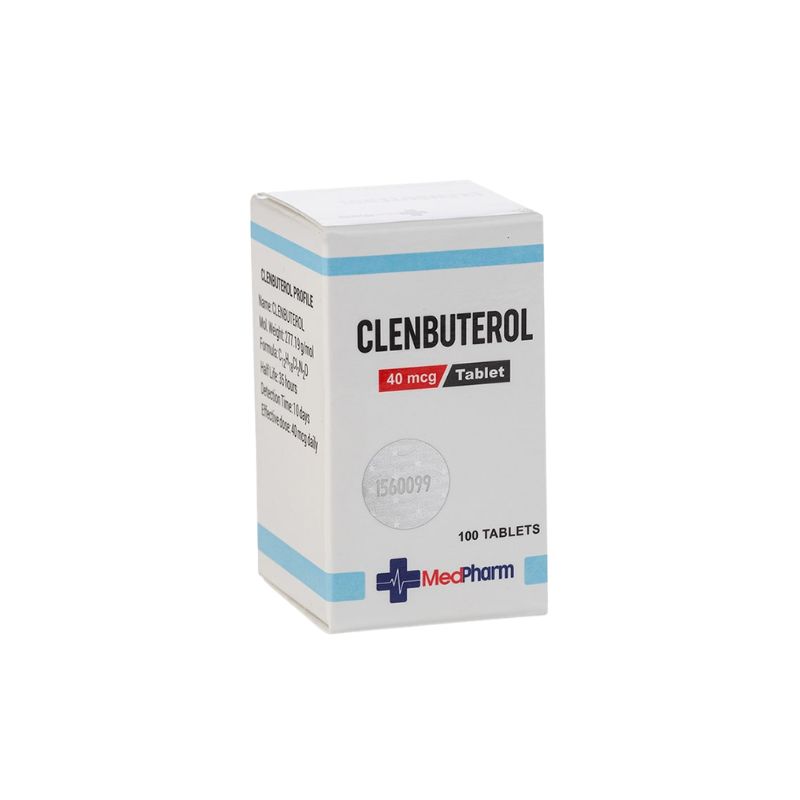 Clenbuterol (Clenbuterol 40 mcg)
Clenbuterol has a reputation problem and a data problem, and they are not the same problem. The reputation comes from sport. The data problem is simpler and stranger: for decades the compound was described as a fat burner, and there has never been a trial in healthy men that measured fat mass. The one randomised study in healthy men that measured it was published in 2025, involved eleven people and two weeks, and found no effect on fat at all.
The one randomised study in healthy men
Eleven healthy men aged 18 to 40 completed two two-week cycles of oral clenbuterol at 80 micrograms a day or placebo, separated by a three-week washout. Body composition, cardiorespiratory fitness, sprint power, cardiac left ventricular mass and intravascular blood volume were measured during each cycle, with vastus lateralis biopsies for muscle protein content and enzyme activity.
The result that matters for the fat-loss claim is the absence of one. Clenbuterol produced a lean mass gain of 0.91 kg (95% confidence interval 0.02 to 1.81, P<0.05) and had no effect on fat mass.
The result that matters for the fitness claim is a decrease. Maximal oxygen uptake fell 7% (P<0.001) and exercise capacity fell 4% (P<0.001). Sprint power output was unaffected, as were left ventricular mass, intravascular blood volume and haemoglobin mass. Inside the muscle, protein content and the endothelial marker PECAM-1 rose, while the fat-oxidation enzyme 3-hydroxyacyl CoA dehydrogenase fell (P<0.01) and oxidative phosphorylation complex V fell (P<0.05).
The last number in that study is the one that is easy to miss. Clenbuterol activated muscle protein kinase A (P<0.001) and phosphorylated ribosomal protein S6 at Ser235/236, but the response declined across the two-week cycle. That is receptor desensitisation, measured in human muscle, over fourteen days, and it is the mechanistic partner of the fitness drop.
Eleven men, fourteen days per cycle, 80 micrograms a day. That is the entire randomised healthy-volunteer record, and the paper says as much in its opening line: the compound remains unexplored in randomised controlled trials.
The disease trials, which are the rest of the record
Everything else that has been measured in humans was measured in people who were ill.
In 71 patients with brachial plexus injuries, a randomized, double-blind, placebo-controlled trial gave clenbuterol 60 micrograms twice daily or placebo for three months, with physical examination, biceps brachii biopsies, electromyography and laboratory testing before and after. Clenbuterol significantly mitigated the decreases in cross-sectional areas of type I and type II muscle fibres and reduced the reduction in fibrillation potential amplitudes. The authors report the treatment was tolerated without adverse effects.
In spinal and bulbar muscular atrophy, twenty patients were given oral clenbuterol 0.04 mg a day for twelve months and sixteen completed. Walking distance covered in six minutes and forced vital capacity increased significantly and sustainedly (p<0.001). Medical Research Council strength scores and the revised ALS functional rating scale did not change. Serious side effects, including those on heart function, were absent, and serum creatine kinase rose significantly. The authors classify this as Class IV evidence, which is the lowest grade on that scale.
Both trials are real and both are about muscle that was already being lost. Neither enrolled healthy men, neither measured fat mass as an endpoint, and neither was designed to answer whether the compound burns fat.
The heart-rate data exists, and it is small
A 2021 randomized controlled trial collected smartwatch heart-rate data from 12 patients with Parkinson disease, four on placebo and eight on clenbuterol, over a six-day baseline and seven days of treatment. Asleep heart rate rose by 3.79 beats per minute (P=.04) from the first night, and awake heart rate rose by 8.79 bpm (P=.001) by the third day.
The trial’s stated purpose was to test whether at-home smartwatch readings can detect a treatment effect in a clinical trial at all. Clenbuterol was the compound chosen to produce one. It is a clean demonstration of an effect on heart rate in 12 people, and it is not a cardiovascular outcome study.
The case reports are not a separate category
A 22-year-old male bodybuilder who had taken stanozolol, clenbuterol and triiodothyronine for ten days presented with jaundice, progressive breathlessness, cough and haemoptysis, and was diagnosed with dilated cardiomyopathy and acute hepatic injury. The authors note that rapidly progressive dilated cardiomyopathy and acute hepatic injury in a bodybuilder over so short a period had not been reported before.
The supply chain is a second reason the human record looks the way it does. A 2018 review of adulteration practices, covering literature to January 2017, identifies clenbuterol among the pharmacologically active cutting agents found in heroin, alongside levamisole in cocaine and other agents in other drugs. That paper is not about clenbuterol’s pharmacology. It is about what a street-market tablet may actually contain, and it is in PubMed because the harm is pharmacological.
Why the fat-burning claim is untested in humans
Four reasons, and all four are visible in the sources above.
First, no trial in healthy men measured fat mass until 2025, and in that trial fat mass did not move. Second, the fat-mass reductions in the literature come from rodents. A 2021 study in mice on a high-fat diet reports reductions in whole-body, visceral and gonadal fat with a controlled-release intradipose clenbuterol hydrogel, and it is a mouse study with a delivery system no human uses. None of it transfers without a human dataset, and there is none.
Third, the mechanism that would produce fat loss in humans, activation of the beta-2 adrenoceptor and the resulting rise in energy expenditure, is the same mechanism that cost the 11 healthy men 7% of their maximal oxygen uptake in the very trial that found no fat loss. Fourth, the rodent datasets and the human dataset do not even agree on which direction the compound works in, and where they disagree the human number is the one that counts.
Where this sits on the shelf
The clenbuterol on this catalogue is clenbuterol 40 mcg. For the other catalogue compound whose page is about what a label does and does not license, oxandrolone: label and warnings is the companion piece on this desk.
What the data do not show
They do not show fat loss in healthy men, because the only trial in healthy men that measured fat mass found no effect on it. They do not show a preserved aerobic capacity, because in that same trial maximal oxygen uptake fell 7% and exercise capacity fell 4%. They do not show a strength gain in the disease trials, because the strength scales did not move in either of them. They do not show anything about long exposure, because the longest human study on this page ran twelve months at 0.04 mg a day in a genetic motor-neuron disease. And they do not separate clenbuterol from the other compounds in the case reports, where it was always taken in combination.
What we supply
The clenbuterol preparation above, as supplied by the manufacturer, tracked, from inside the EU.
Research use only. This page summarises published studies for research reference. It is not medical advice, not a protocol, and not a suggestion for human use. Nothing we supply is for human or veterinary use.
References.
- Hostrup N, Moesgaard L, Fischer T, et al. Clenbuterol induces lean mass and muscle protein accretion, but attenuates cardiorespiratory fitness and desensitizes muscle beta2-adrenergic signalling. J Physiol 2025;603(19):5529-5545.
- Jiang Z, Gu B, Zhang G, et al. Randomized, double-blind, and placebo-controlled trial of clenbuterol in denervated muscle atrophy. ISRN Pharm 2011;2011:981254.
- Querin J, D'Ascenzo S, Peterle E, et al. Pilot trial of clenbuterol in spinal and bulbar muscular atrophy. Neurology 2013;80(23):2095-2098.
- Elzinga WO, Prins S, Borghans LGJM, Gal P, Vargas GA, Groeneveld GJ, Doll RJ. Detection of clenbuterol-induced changes in heart rate using at-home recorded smartwatch data: randomized controlled trial. JMIR Form Res 2021;5(12):e31890. PMID 34967757 (12 patients with Parkinson disease, 6-day baseline then 7 days on clenbuterol or placebo; smartwatch HR, not a cardiovascular outcome study.)
- Li C, Adhikari BK, Gao L, et al. Performance-enhancing drugs abuse caused cardiomyopathy and acute hepatic injury in a young bodybuilder. Am J Mens Health 2018;12(5):1700-1704.
- Solimini R, Rotolo MC, Pellegrini M, et al. Adulteration practices of psychoactive illicit drugs: an updated review. Curr Pharm Biotechnol 2017;18(7):524-530.
- Chen L, Lin Y. Oxidized hyaluronic acid hydrogels as a carrier for constant-release clenbuterol against high-fat diet-induced obesity in mice. Front Endocrinol 2021;12:572690.


