IGF-1 LR3: the compound the literature tested in sheep
Long R3 IGF-1 is the engineered IGF-1 analogue that resists IGF-binding proteins, and the reason it was built. The indexed experimental record is fetal sheep: infused into the fetal circulation to ask whether it would make a growth-restricted lamb grow. In 2025 it did not.
11 November 2026 · 4 min read
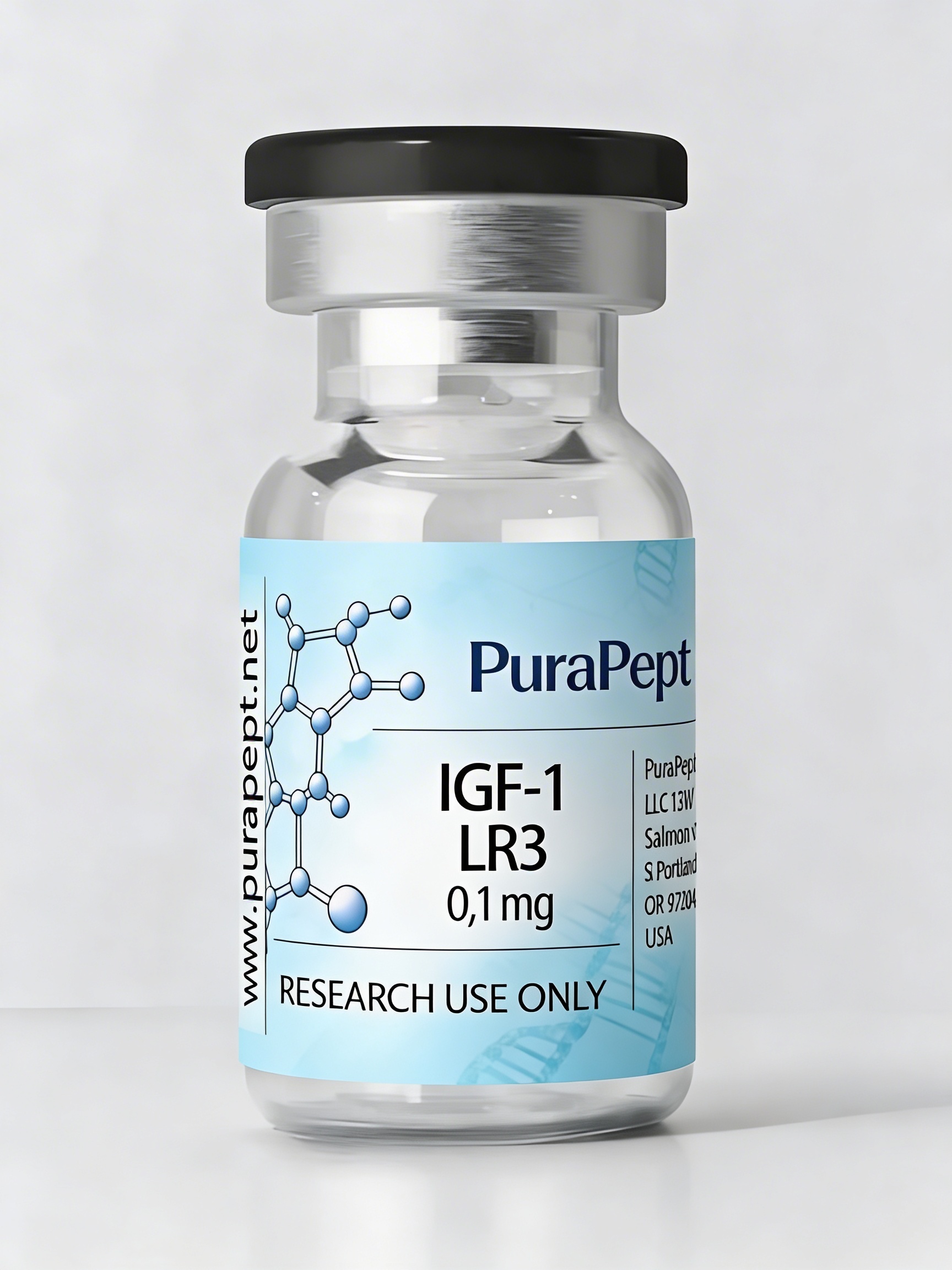 IGF-1 LR3 0.1 mg
IGF-1 LR3 is the engineered version of insulin-like growth factor 1 — “Long R3”, with three amino acids substituted at the N-terminus so that it binds the IGF-1 receptor with high affinity while binding the IGF-binding proteins with low affinity. That design is the entire reason the molecule exists: native IGF-1 spends most of its life parked on binding proteins, and the engineered version is meant to escape them. The interesting question is what has been measured with it, and the answer is more specific than anyone selling it would suggest.
Why the molecule was engineered
The 2023 production paper states the design logic plainly: IGF-1 is a pleiotropic protein hormone and an attractive therapeutic target because of its roles in growth, development and metabolism, but its production is hindered by low, heterogeneous expression levels in existing systems. Long R3 IGF-1 is the analogue produced alongside standard IGF-1, and the paper’s finding relevant to anyone who wants a working molecule is that purified IGF-1 and LR3 IGF-1 display excellent bioactivity of cell proliferation compared to the standard IGF-1 — that is, the engineered version is not a degraded copy, it retains the receptor activity the design was meant to preserve.
That paper is about expression. It is not a physiological study and it makes no claim about what the molecule does in a living animal or a person.
The main experimental record is fetal sheep
The 2025 paper is the most direct test of the compound’s purpose, and its result is negative. Placental insufficiency can cause fetal growth restriction, with low circulating IGF-1 and insulin and attenuated glucose-stimulated insulin secretion, which the authors note likely contribute to neonatal glucose dysregulation. The question they asked was whether the growth-promoting molecule could reverse that.
They infused IGF-1 LR3 directly into the fetal circulation of growth-restricted fetal sheep for one week — seven animals per arm — and measured fetal body weight, insulin, glucose, oxygen, amino acids and glucose-stimulated insulin secretion before and after. The result:
Fetal body weights, insulin, glucose, oxygen, and GSIS were not different between groups.
The one significant change was a reduction in circulating amino acids in the treated group (P = 0.0232, against P = 0.3866 in the vehicle arm). The authors’ interpretation is careful and worth quoting in the same careful way: the reduction could reflect increased amino acid utilization, and they speculate that maintaining amino acid concentrations, or raising insulin, glucose and oxygen to values consistent with normally growing fetuses, may be necessary for the molecule to increase fetal growth in that setting.
Read against the same group’s earlier work — a one-week infusion into normal fetal sheep that increased body weight but lowered insulin and GSIS — the pattern is consistent. The molecule is active on growth signalling. Making a growth-restricted fetus actually grow is a harder problem than signalling harder, and in this model the extra signalling did not do it. Amino acid concentrations fell in both situations, which is the most interesting single observation in the file: it is what a system diverting substrate into tissue looks like whether or not the outcome is growth.
The heart, the nerve and the receptor
Two further papers describe where the compound’s activity has been localised in animal work.
In fetal sheep cardiomyocytes, LR3 IGF-1 increased bromodeoxyuridine uptake three- to five-fold, and blocking either the extracellular signal-regulated kinase or the phosphoinositol-3 kinase cascade completely abolished that response. The authors’ four conclusions are precise and worth repeating in summary: IGF-1 through IGF1R stimulates cardiomyocyte division in vivo and hyperplastic growth is the most likely explanation of the heart growth seen; it does not stimulate binucleation in vitro or in vivo; it does not stimulate hypertrophy in either; and it requires both signalling pathways for proliferation. In vivo administration of LR3 IGF-1 did not stimulate cardiomyocyte hypertrophy and instead lowered the percentage of binucleated cells.
In a 2025 tissue-engineering paper, a decellularised plant-stem nerve conduit was built to release IGF-1 LR3 in a controlled way across a 1 cm sciatic nerve defect in thirty rats in six groups of five. The controlled-release conduit significantly improved axonal regeneration and performed comparably to autologous nerve grafts without inducing systemic toxicity. That is a biomaterials result about a scaffold, not a result about the peptide: the peptide’s role in it is as a released factor inside a device.
For context on where the whole class sits, the 2023 sarcopenia review compiles the trial record across IGF-1 among many other agents and concludes that although some were effective in improving muscle mass or strength, this was not translated into clinically relevant improvements on physical performance, that no drug is currently approved for the indication, and that most trials were run in different populations with the components of the syndrome measured separately.
What this record does not show
Not a human study. Every physiological result on this page is in fetal sheep or cultured cardiomyocytes, and the nerve study is in rats.
Not a growth result in the model designed to test growth. The 2025 paper’s headline is a null result on fetal body weight.
Not a muscle-building record. The sarcopenia review’s summary of the class — mass and strength improved, physical performance not — is the closest published statement, and it is a statement about IGF-1 among many agents, not about LR3 specifically.
Not a statement about the vial. Whether a given preparation contains active LR3 is answered by batch documentation, not by the biology literature.
What we supply
IGF-1 LR3, as supplied by the manufacturer, tracked, from inside the EU. Batch documentation for any product that carries it is explained in the COA guide linked from the product page.
There is something worth learning from a compound whose most careful experiment is a negative result in lambs. Growth signalling is not the same thing as growth, and the substrate has to be there. Research use only. This page summarises published animal physiology and receptor pharmacology for research reference. It is not medical advice and not a suggestion for human use. Nothing we supply is for human or veterinary use.
References.
- White A, Stremming J, Wesolowski SR, Al-Juboori SI, Dobrinskikh E, Limesand SW, et al. IGF-1 LR3 does not promote growth in late-gestation growth-restricted fetal sheep. Am J Physiol Endocrinol Metab 2025;328(1):E116-E125 (PMID 39679943).
- Sundgren NC, Giraud GD, Schultz JM, Lasarev MR, Stork PJ, Thornburg KL. Extracellular signal-regulated kinase and phosphoinositol-3 kinase mediate IGF-1 induced proliferation of fetal sheep cardiomyocytes. Am J Physiol Regul Integr Comp Physiol 2003;285(6):R1481-R1489 (PMID 12947030).
- Yavuz E, Sağır MS, Ercan A, Erginer M, Barlas FB, Sakarya D, et al. Revolutionary decellularized Alstroemeria stem-based nerve conduit integrated with GelMA and controlled IGF-1 LR3 release for enhanced rat sciatic nerve regeneration. Int J Biol Macromol 2025;329(Pt 2):147888 (PMID 41015370).
- Lu Z, Liu N, Huang H, Wang Y, Tu T, Qin X, et al. Recombinant expression of IGF-1 and LR3 IGF-1 fused with xylanase in Pichia pastoris. Appl Microbiol Biotechnol 2023;107(14):4543-4551 (PMID 37261455).
- Rolland Y, Dray C, Vellas B, Barreto PS. Current and investigational medications for the treatment of sarcopenia. Metabolism 2023;149:155597 (PMID 37348598).