Tadalafil on demand or once daily: the two trials that asked both
The same molecule on two schedules is not one drug in two pack sizes. A three-arm open-label study found the daily and on-demand tadalafil schedules indistinguishable on the conventional endpoints and separated only on spontaneity; a 423-patient post-prostatectomy trial found the daily schedule reached time-to-recovery faster while the on-demand schedule did not separate from placebo. Here is what each trial actually asked.
9 November 2026 · 5 min read
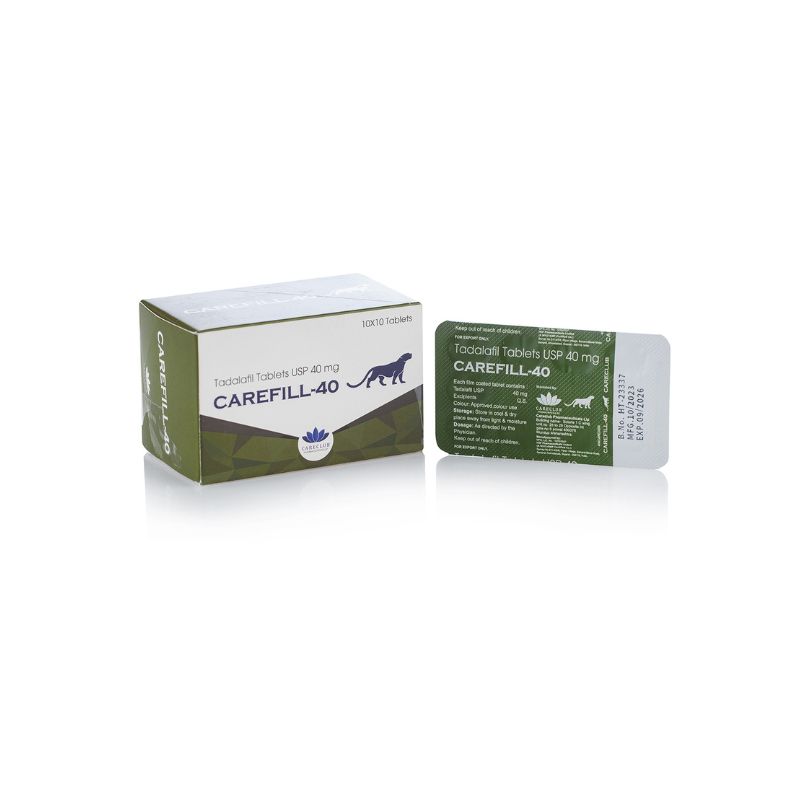 Carefill-40 (Tadalafil 40 mg)
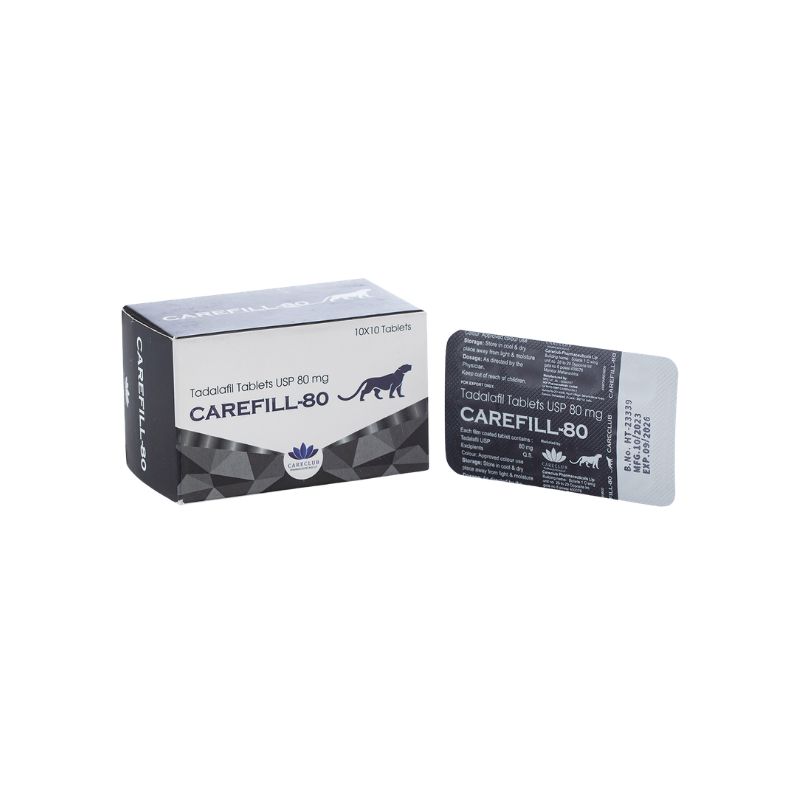
Tadalafil is the one molecule in this catalogue that is prescribed in two genuinely different ways, and the difference is not a packaging preference — it is a different clinical question with a different endpoint. The products on this page are the daily and on-demand strengths supplied in this catalogue, including Carefill-40. The honest way to read the evidence is to separate the two trials that actually put both schedules head to head from the marketing that treats them as interchangeable.
Why a schedule is a pharmacological property, not a preference
A 2011 patent survey of the PDE5 field describes the first generation of these inhibitors — sildenafil, vardenafil, tadalafil — as perceived to have flaws in selectivity over other phosphodiesterases, expressed as slow onset, duration of action, or central nervous system penetration. It goes on to note that sildenafil and vardenafil are approved worldwide while tadalafil is the third of the trio, and that further research has been aimed at agents with different biological or pharmacokinetic profiles.
That sentence is the reason the daily schedule exists. Tadalafil’s distinguishing pharmacokinetic feature is a long window of activity, and a molecule with a long window can be used in two ways: taken at the moment of need, or taken continuously so that the effect is already there when it is wanted. The two schedules share a molecule. They do not share an endpoint.
The three-arm study: identical on the headline, different on spontaneity
The largest randomised comparison of the two schedules in treatment-naive men was an open-label study across eight weeks of assigned treatment, followed by sixteen weeks of pragmatic treatment in which switching between inhibitors was allowed. Men were randomised to the daily tadalafil schedule (257), the on-demand tadalafil schedule (252) or on-demand sildenafil (261), with adjustments permitted.
The results divide cleanly in two, and both halves matter.
What did not differ. Improvements in the GAQ and SEP responses, in the erectile function domain of the IIEF, in orgasmic function, sexual desire, overall satisfaction, the SEAR questionnaire and the EDITS treatment-satisfaction instrument did not differ significantly between the treatment groups. On the endpoints that most of the published tadalafil literature reports, the daily schedule and the on-demand schedule of the same molecule were the same drug.
What did differ. Sexual self-confidence improved more on both tadalafil schedules than on on-demand sildenafil — least-square mean change of +0.90 (0.048) daily and +0.93 (0.050) on demand, against +0.73 (0.049) for sildenafil, at P = 0.006 and P = 0.001. Spontaneity moved in the same direction: +0.11 (0.035) daily and +0.13 (0.035) on demand against +0.02 (0.035) for sildenafil, P = 0.044 and P = 0.010.
The structure of that finding is worth stating carefully, because it is routinely misreported. Spontaneity is a property of the relationship between the drug and the schedule, and it separated tadalafil from sildenafil. It did not separate the daily tadalafil schedule from the on-demand tadalafil schedule — the two tadalafil arms are within a few thousandths of each other on both scales.
The 423-patient trial: where the schedules genuinely part company
The second trial asked a harder question in a harder population. After bilateral nerve-sparing radical prostatectomy, patients were randomised 1:1:1 to nine months of double-blind treatment with daily tadalafil, on-demand tadalafil, or placebo, then a six-week washout and three months of open-label daily treatment. 423 patients were randomised (139 / 143 / 141).
The endpoint was time to erectile function recovery, defined as an IIEF erectile function score of at least 22. Results:
- Proportion reaching that threshold at some point during blinded treatment: 29.5 % daily, 23.9 % on demand, 18.4 % placebo.
- Time for a quarter of patients to reach recovery: 5.8 months (95 % CI 4.9, 9.2) daily, against 9.0 (5.5, 9.2) on demand and 9.3 (9.0, 9.9) placebo.
- Overall treatment effect significant at p = 0.038; recovery probability significantly higher for daily versus placebo, hazard ratio 1.9 (1.2–3.1), p = 0.011 — and not significant for on demand versus placebo, p = 0.140.
Two honest caveats belong immediately next to those numbers. The trial’s own authors state that the blinded phase was too short for a majority of patients to reach recovery, and that the median time to recovery was non-estimable. And the study population is men recovering from prostate surgery, which is not the general erectile dysfunction population.
But the shape of the finding is real and it is the clearest published separation of the two schedules: continuous treatment moved the recovery curve, and the as-needed schedule did not separate from placebo on that endpoint.
What the class-level evidence adds, and what it does not
A 2009 systematic review and meta-analysis of oral PDE5 inhibitors pooled short-term trials of twelve weeks or less. Intercourse success was 69.0 % versus 35.0 % on placebo; the proportion of men with improved erections ranged 67.0–89.0 % on drug against 27.0–35.0 % on placebo; and adverse events were more frequent with treatment, with a relative risk of 1.72 (95 % CI 1.53–1.93) for sildenafil. In four head-to-head randomised trials comparing sildenafil, vardenafil and tadalafil, neither improvement in erectile function nor adverse events differed between the treatments.
That last line is the one most often left out. Across the class, head-to-head trials are few, short, and — in the review’s own assessment — many were of low methodological and reporting quality. No head-to-head comparison produced a winner.
The problem a daily schedule actually creates
A 2025 cross-sectional analysis of adherence to the daily tadalafil schedule enrolled 233 patients with erectile dysfunction and measured adherence with the Medication Adherence Report Scale, alongside the IIEF, a Brief Illness Perception Questionnaire and the Beliefs about Medicines Questionnaire. High adherence was reported in 136 of 233 (58.4 %). Multivariate analysis identified monthly income and a history of radical pelvic surgery as significant predictors, and adherence was significantly associated with IIEF scores and with the questionnaire subscales for specific concerns, necessity and general harm.
Fifty-eight per cent is not a supply problem or a pharmacology problem. It is a behaviour problem, and it is the strongest practical argument in this file for the on-demand schedule being a reasonable choice rather than a lesser one.
What this record does not show
Not that one schedule is better. Across class head-to-head trials, no difference was found. The three-arm open-label study found no difference on the conventional endpoints.
Not that the daily schedule is interchangeable with the as-needed one. In the prostatectomy trial the daily schedule separated from placebo on time to recovery and the as-needed schedule did not.
Not a claim about any individual. Everything above is a population statement from trials. Drug choice is a clinical decision made with a clinician.
Not a statement about doses or regimens. This page reports what each trial measured. It does not instruct anyone on how to take anything.
What we supply
Carefill-40 and Super Carefill, tadalafil tablets as supplied by the manufacturer, tracked, from inside the EU. Batch documentation for any product that carries it is explained in the COA guide linked from the product page.
Research use only. This page summarises published randomised trials and systematic reviews of PDE5 inhibitors for research reference. It is not medical advice and not a suggestion for human use. Nothing we supply is for human or veterinary use.
References.
- Hatzimouratidis K, Buvat J, Büttner H, Vendeira PA, Moncada I, Boehmer M, et al. Psychosocial outcomes after initial treatment of erectile dysfunction with tadalafil once daily, tadalafil on demand or sildenafil citrate on demand: results from a randomized, open-label study. Int J Impot Res 2014;26(6):223-229 (PMID 24784894).
- Moncada I, de Bethencourt FR, Lledó-García E, Romero-Otero J, Turbi C, Büttner H, et al. Effects of tadalafil once daily or on demand versus placebo on time to recovery of erectile function in patients after bilateral nerve-sparing radical prostatectomy. World J Urol 2015;33(7):1031-1038 (PMID 25155034).
- Tsertsvadze A, Fink HA, Yazdi F, MacDonald R, Bella AJ, Ansari MT, et al. Oral phosphodiesterase-5 inhibitors and hormonal treatments for erectile dysfunction: a systematic review and meta-analysis. Ann Intern Med 2009;151(9):650-661 (PMID 19884626).
- Kandemir E, Kucuktopcu O. Assessing medication adherence to tadalafil 5 mg once daily in erectile dysfunction: a cross-sectional analysis. Pharmacol Res Perspect 2025;13(3):e70129 (PMID 40448337).
- Bell AS, Palmer MJ. Novel phosphodiesterase type 5 modulators: a patent survey (2008-2010). Expert Opin Ther Pat 2011;21(10):1631-1641 (PMID 21905762).